Chess Variants
Howdy! It’s the Chess Friends!
Thanks for all the amazing feedback on our Northwest Chess November article: Executive Chess. We’re thrilled to hear that our tips to grow your executive functions through chess are helpful!
Today we’re going to have some fun and talk about chess variants! There are SO many fun variants out there, which use chess as a platform to play a different game! In this post, we’ll highlight Bughouse, Atomic Chess, and Duck Chess!
Bughouse
Hey Friends! It’s The Legend Vivi here! Today I’m going to be talking about Bughouse, my favorite variant! Bughouse is a two-on-two team game! I play it a lot, and my most exciting result was winning 5th at SuperNationals (which is the biggest scholastic chess event happening every four years) in Bughouse, with my bro The Myth Sarang. Check this out: U.S. Women’s Champion IM Carissa Yip gave us our medals!

Bughouse is played on two boards, and you and your partner have opposite colors, sitting next to each other. Typically, it is played with a blitz time control of 3 minutes or 5 minutes per side for the whole game. Whenever you take a piece, you pass it to your partner and they are allowed to place that piece anywhere on their board that is a legal square for that piece, excluding a pawn promoting. It’s super chaotic, loud, fast-paced, and you can take Kings!
Stalling, aka waiting, is also an important tactic because the game ends when either opponent's King is mated or taken or they flag (run out of time). For example, suppose I am about to lose, and my partner is about to win. If I am up on time on my partners’ opponent, then I can just wait and have my partner win their game. Speed is key!
I also love Bughouse because you can sacrifice pieces a lot more and be hyper aggressive! For example, sacrificing a Bishop or Knight on f7 to open up the defending King is often amazing! Let me show you. Suppose a game starts with normal stuff like: 1. e4 e5, 2. Bc4 Nf6, 3. Bxf7! Kxf7.

In this position, the key is to get a Knight from your partner and place it on g5 as shown here.
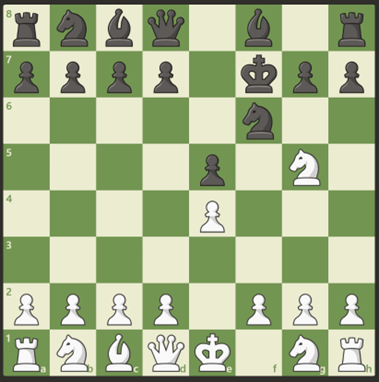
Here Black is in some trouble. There are four options for the King, namely Ke8, Kg8, Kg6, and Ke7. Kg8 is by far the worst option because even a pawn can checkmate it:

Note that communication is very important in this game. Sometimes you can even tell your partner sac your queen for a pawn. Going back to the initial sacrifice, suppose the King goes to e7. Now you place a Knight on f5, they must play Ke8, then placing a pawn on f7 is checkmate:

Going back to the original sac, suppose the King goes to e8. The order just switches and you first place a pawn on f7, the King must go to e7, then place a Knight on f5 mate. Note in both these lines, your partner will need to get you two Knights and a pawn, which is not easy, but is very possible, especially with Bishop pins. Also, note that these ideas work with Nf3 on move 2 then Ng5 then sacrificing the Knight on f7. Note that if the King comes up to g6, it is so exposed, that there are so many ways you can win even without your partner giving you lots of pieces.
I’m going to stop here now to let my brother, The Myth Sarang, and The Man Benji write their bits, but give Bughouse a try! It’s probably the most fun you’re going to have playing chess! Over to you bruzzer!
Atomic Chess

Hey Friends, It’s a me, The Myth Sarang! Today I will be covering Atomic Chess, one of my absolute favorite variants! Standard rules of chess apply, but every capture results in an explosion! The explosion affects the capturing piece, the captured piece, and all of the surrounding pieces of both colors (a 3 x 3 grid with the square you moved to at the center), other than adjacent pawns! To win, you need to explode your opponent’s king without exploding your own king, also known as “atomic checkmate”. So now you know that the King cannot take any piece because it would explode itself, which means you could put two Kings next to each other. This variant is very popular, with 5 million atomic games played on Lichess in 2021! The German Internet Chess Server (GICS) introduced this game in 1995, before being applied to bigger servers like Internet Chess Club (ICC) in 2000, and was later introduced to Lichess in 2015, and Chess dot com in late 2020. Let’s talk about an opening with a super quick win.
White starts with a +4 advantage in Atomic Chess, and many openings try to explode Black’s d, e or f-pawns, exploding the king and winning. Here’s an opening trap. White starts with 1. Nf3, the Reti, and Black plays 1… d5, shown below.

Then White plays Ne5, threatening Nxf7, exploding the king and winning. Black will lose in up to 2 more moves. Black has to play 2… f6 or f5, and White plays Nd7, where if Black takes the Knight, they explode their own King, and if we take their bishop, which is unstoppable, we win! This is shown below.

Give Atomic Chess a try! It’ll blow your mind!
Quack, quack! It’s Duck time! Turning it over to The Man Benji!
Duck Chess
What's good, buddies? It is I, The Man Benji! I have very little experience with variants. I’ve never played Chess-960 with all of those scrambled openings, 4-Player Chess where you play on a 160-squared board, or Spell Chess, where magic meets chess (yes, that’s a variant also!). Out of all the chess variants, my favorite is Bughouse, but Duck Chess is a close second. Without feather ado, let me show you what Duck Chess is all about!

It is believed there are many old variations of this game, but modern Duck Chess was invented in 2016 by Dr. Tim Paulden, a mathematician, who is also the president of Exter Chess Club in Devon, England. It’s just like your regular chess game, but with a new piece: The Duck! Unlike the black and white regular pieces, there is only one duck that the players share each turn, because… sharing is caring!
After you move your piece, you pick up the duck, and place it on an empty square, and then your opponent makes a move, picks up the same duck and puts it on the square of their choice. The duck has a blockading effect. No piece can jump over the duck (except knights), and the duck cannot be captured.
For example, you could play 1.e4 and place the duck on e6 to stop the French and 1.e5!

Since we have effectively stopped any e-pawn for Black, they decide to play 1.c5. Then, they take the duck from e6 and place it on f3 to stop Nf3.

Then, we’ll get a less common Sicilian line. It can be very frustrating when the duck prevents you from castling or developing your last piece, too!
The duck isn’t just a menace in the opening; it can also be very helpful for some tactics. For example, in this position below, Black to move, how could we trap the White bishop in a way that wouldn’t be possible in normal chess?

Yes, egg-zactly! Like a sitting duck, the bishop has no safe square! No matter what White does, their bishop is going to get lost:

The game also ends differently in duck chess. There is no checkmate! Instead, the game ends when the king is taken. The reason for this is because you can often block what would normally be checkmate with the duck!
Also, when you stalemate your opponent (which is a draw in normal chess), you lose in Duck Chess! This happens when you are not able to make a single move, because the pieces and the duck are blocking you.
There you have it, friends: a quack, I mean, a quick intro-duck-tion into duck chess! Try it on Chess.com, or play it with your friends! Good duck! I mean, good luck! You don’t even need to have a duck to play! A piece of candy, or even any action figure would do!
If you want to get really competitive with any of the chess variants, there is a community tournament on Chess.com every month, where they pick a variant and make a big championship out of it. The November Crazyhouse Championship actually finished a few days ago. In September, they hosted Duck Chess, won pretty convincingly by IM Nhat Minh To. You can read the news coverage about that here.
That’s it for today, friends, but don’t go anywhere just yet!

We have some knee slappers to quack you up!
Why did the duck win its chess game?
It found a really good quacktic!
***
Yes, I saw that game. It was egg-selent!
***
Why does the duck always pace up and down the tournament hall during the chess game?
It doesn’t want to be a sitting duck!
***
What did the duck say when it lost its rook?
Waddle I do without my rooook!
***
Three Cheers, Fellow Future Master Chess Friends!
The Man Benji, The Myth Sarang, The Legend Vivi


Comments