Of Cabbages and Kings
- Feb 26
- 5 min read
Howdy, it’s the Chess Friends!
Cabbages?!? What in the world is this title, you might ask? Lettuce give you a clue:
"The time has come," the Chess Friends said,
To talk of many things:
Of rooks—and pawns—and en passants, —
Of cabbages—and kings.
If that still doesn’t make sense, no worries! Peshka was also confused:

Today, the Man Benji travels to the past to review a classic book, the first ever chess-themed novel for kids. Some also consider it to be the first true novel for kids. Friends, let me introduce you to...
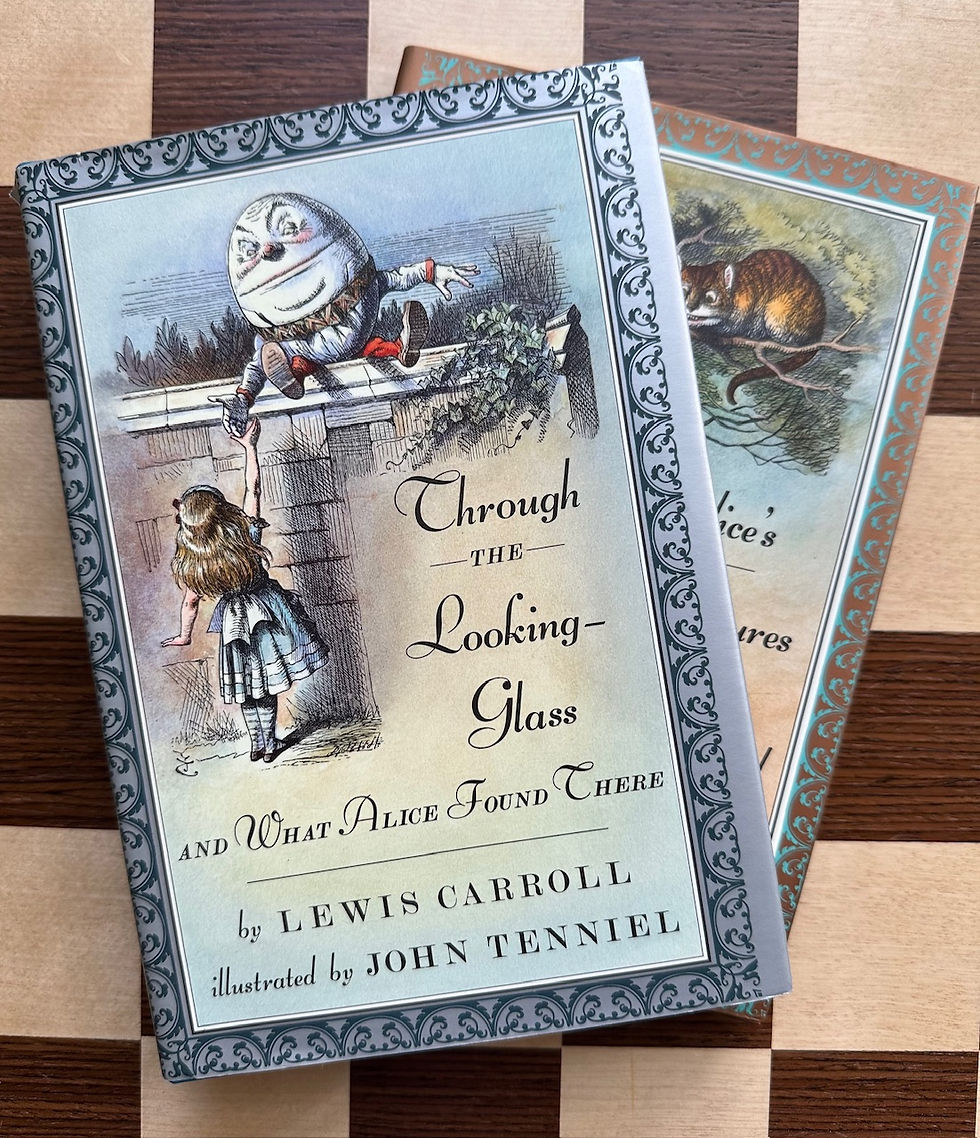
Lewis Carroll’s Through the Looking Glass and What Alice Found There,
published in December 1871, a less-known sequel to his 1862’s Alice’s Adventures in Wonderland, both illustrated by John Tenniel. (Because, according to Alice, “what is the use of a book without pictures.” True that!)
You see, back in the days, grownups wrote books for kids with only one purpose: to teach some kind of a moral lesson, usually in a scary way, so kids would obey the adults and behave better. Then came Lewis Carroll, who put a stop to all that boring stuff and created a whimsical world to entertain and amuse kids. It was so unusual and refreshing, that his books became an instant success. Before I get to the book, though, let me talk about the author himself.

Lewis Carroll is a pen name for Charles Lutwidge Dodgson, a mathematician, teacher, writer, photographer, word player, and chess player! He was born in 1832 in Cheshire, England, educated at the Oxford University, where he stayed to teach math while writing scholar works on math and logic and, most famously, writing children’s books where logic was twisted and turned inside out.
He didn’t just write books, he also invented word games, like an early version of Scrabble, and Word Ladder, where you start with one word and change one letter at a time to get a new word, something like this:
KING
RING
RINK
RANK
RACK
ROCK
ROOK
RO-O-O-OK!!!
Lewis Carroll also created the concept of portmanteau words, when two different words are mashed together to create a word that means both of those things. Like breakfast and lunch become brunch, or being hungry and angry makes someone hangry.
We can create a chess portmanteau! Let’s take time and scramble and make tramble. So, next time you are playing a blitz game, try not to get yourself into too much tramble.
Lewis Carroll enjoyed teaching and playing the game of chess. Though his actual games were not recorded, he was known to always pack a travel chess sets on his long journeys, because you never know if your travel companion would want to play! Hey, that’s what we, The Chess Friends, and Lewis Carroll have in common: we too travel with a chess set, and we too love word play! If you noticed, most of our knee-slappers are word plays, one way or the other.
But lettuce go back to our title, Cabbages and Kings! The little verse at the beginning of the post is our rendition of the part of the poem “Walrus and Carpenter” from Through the Looking Glass. What is the book exactly about? I’ll explain. It’ll be hard, but I’ll try.
After Alice returned from her trip down the rabbit hole in the first book, she is at home, quite bored on a snowy day, so she decides to step through the looking glass (which people called a mirror in the olden days) to explore what the world is like there. As expected, things there are a bit strange. Chess pieces are alive. Talking flowers. Butterflies with bread-and-butter wings. And check this out: “It’s a great huge game of chess that’s being played—all over the world—if this is the world at all, you know.”

She really wants to be a part of that chess game, so the Red Queen suggests Alice to start as a pawn on the 2nd rank and travel through the board all the way to the 8th rank to become a queen!
Here is her journey:


The moves do not strictly follow chess reasoning, but hey, it’s a strange world out there, on the other side of the mirror, so that’s OK! Along the way, Alice encounters many characters in peculiar situations that most of the time don’t make any sense.
Or... do they?...
For example, the White Queen and Alice have this conversation, where Alice says,
“I can’t remember things before they happen,”
and the White Queen responds,
“It’s a poor sort of memory that only works backwards.”
At first, I was… wait… what?... How can we remember what happens tomorrow? But then, I thought of Maurice Ashley’s Move by Move book (reviewed in our last week’s blog), where he says that gaining your “future” wisdom helps you move forward in your present.
So, Lewis Carroll is hinting at the same thing: listen to your elders, because they are talking to you from your future. Lewis Carroll doesn’t deliver this lesson directly, as in so many books written for kids during his time. In his books, the kids are free to think for themselves and find their own understanding.
Oh, and Peshka wants to share its own interpretation of the Red Queen’s advice, “Speak in French when you can’t think of the English for a thing.” Basically, speak in French when you can’t think of a move to play:

Some people say that Through the Looking Glass is a story about growing up. Like when kids enter the adult world, they find that the logic that adults live by doesn’t add up, and the world feels backwards. Then, the lesson is to enjoy being a kid, play make-believe, and always remember to talk to flowers and to your chess pieces!
Or maybe Alice entering the world of chess is her escaping the boring cold winters at home. Then, the lesson is: chess is a magical world that helps us forget about what’s outside.
Lewis Carroll ends the story with this:
“Life, what is it, but a dream?”
Well… if it’s a dream, then, my friends, let’s dream big and play chess! And, as the White Queen advises:
“Believe in six impossible things before breakfast!”
Before we let you go, how about a word puzzle? Like Lewis Carroll, The Myth Sarang and The Legend Vivaan love word games and creating their own word puzzles... Here's a fun one for you, inspired by The New York Times Strands game.

The goal is to find words going in any orientation (it's ok to zig and zag), and every letter in the puzzle must be used exactly once! The theme of this one is Q&A Chess, and there are 6 words/phrases hidden! If you want to solve it digitally, you can do so here: Q&A Chess Strands Puzzle. Look out for the extra special SPANGRAM, a word or phrase that spans the puzzle from one side to the other.
Three Cheers, Fellow Future Master Chess Friends,
The Man Benji, The Myth Sarang, The Legend Vivaan


Comments