Chaturanga to Champions
Howdy! It's The Chess Friends!

Chess and India are connected by far more than just strong current players. India is where the game of chess began! The earliest known form of chess was called chaturanga, invented in the 6th century in the Gupta Empire in India. Chaturanga means “four parts”: infantry, cavalry, elephantry, and chariotry, which the pieces represent. In our previous blog post, Historical Chess Pieces, we talked about it in more detail.
Who specifically invented it you ask? We may never know, but Indian legend has it that a man named Sissa created chaturanga to teach strategy and tactics to leaders. The King at the time, Shihram, loved chaturanga so much that he offered Sissa a reward. Sissa requested a single grain of rice on the first square of the 8 x 8 board on the first day, then 2 on the second, 4 on the third, 8 on the fourth, doubling the amount every day for each square of the board. You may have calculated that on day 64, the King had to place 2^63 grains of rice on the final square, or over nine quintillion grains, with the total rice over all 64 squares exceeding 18 quintillion. That’s 18 with 18 zeros after it!
Feels like a great lesson in calculating several moves ahead before playing, whether in chaturanga, chess, or math! We reviewed a picture book retelling of this story in our early blog Chess Picture Books! Oh my!
From India, this war-themed board game traveled west. In Persia it became Shatranj, with rules a little closer to modern chess, and after the Arab conquests it spread further into Europe. Over the centuries, rule changes like the powerful queen and faster bishops turned it into the game we all know and love today.
In the 18th and 19th centuries, chess in India was still played with some local rule differences. Under traditional Indian rules, only the central pawns could move two squares on their first move, and the en passant capture did not exist. When European masters met strong Indian players in places like Calcutta (now Kolkata, a city in West Bengal), they noticed their unusual opening style: instead of pushing central pawns early, Indian players often developed pieces first and delayed pawn moves.
The Scottish chess master John Cochrane, who spent many years in India, helped introduce the term “Indian openings” in chess literature for systems where Black allows White to build a pawn center and then attacks it with better piece development. This is why so many famous defenses have the name Indian in them, such as:
The King’s Indian (1. d4 Nf6 2. c4 g6):
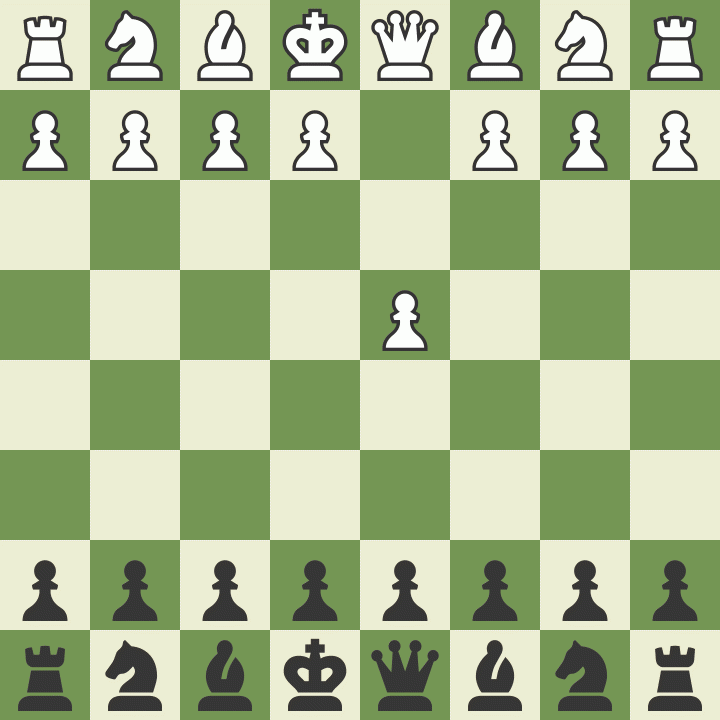
Nimzo-Indian (1. d4 Nf6 2. c4 e6 3. Nc3 Bb4):

Queen’s Indian (1. d4 Nf6 2. c4 e6 3. Nf3 b6):

Bogo-Indian (1. d4 Nf6 2. c4 e6 3. Nf3 Bb4+):

There is even the Indian Game (1. d4 Nf6)!
Organized tournament chess in India began in the 20th century. The All India Chess Federation (AICF) was founded in 1951 to coordinate events and promote the game across the country. The first official Indian Chess Championship in 1955 was won by the late R. B. Sapre, and in 1956, India played in its first ever Chess Olympiad, the largest competition of nations in chess, held in Moscow that year.
In the 1960s, Manuel Aaron, a chess player born in Toungoo (now a city in Myanmar, formerly Burma), became India’s first International Master. These early achievements laid the foundation for a national chess culture with regular tournaments, state associations, and eventually many academies and training programs, including Chess Gurukul, run by top global trainer GM R.B. Ramesh. Top students from Chess Gurukul include GMs Pragg, Aravindh, and Vaishali.
The biggest turning point for Indian chess on a global scale came with Viswanathan (aka Vishy) Anand from Chennai. In 1988, at the age of nineteen, he became India’s first Grandmaster. Anand quickly rose to the very top of world chess, eventually winning the FIDE knockout world title in 2000 in a six-game match against Alexei Shirov. He then held the classical world championship for many years in the 2000s before losing it in 2013 to current world number 1 Magnus Carlsen.
Anand’s success completely changed the landscape of chess in India. He inspired thousands of kids to take the game more seriously, and his achievements showed that World Champions are born in India. Because of him, many people talk about an “Indian chess boom,” with growing media coverage, sponsorship, and a stronger chess culture nationwide.
On the women’s side, Subbaraman Vijayalakshmi became India’s first Woman Grandmaster in 2001, also holding the International Master title and winning multiple national and Commonwealth titles.
By the mid-2000s, other stars such as Koneru Humpy and Harika Dronavalli had become leading female players, regularly representing India on top boards at Olympiads. As of early 2026, India has over 90 Grandmasters, showing how much the country has grown from having just one GM in 1988 to a full “chess superpower.” Other legends on the men’s side that ushered in this modern boom include Surya Shekhar Ganguly, Krishnan Sasikiran, Pentala Harikrishna, and Vidit Santosh Gujrathi, who all helped India compete with lots of strength.
In the current day, a new generation of Indian teenagers has pushed the country into the very top tier of world chess. Players like 19-year-old GM prodigy Gukesh Dommaraju, the current FIDE World Champion and 20-year-old prodigy Rameshbabu Praggnanandhaa, another strong Grandmaster, have already beaten elite grandmasters and competed in top super tournaments while still in their teens. They are often mentioned as possible future world championship contenders, continuing the path opened by Viswanathan Anand. Arjun Erigaisi, Nihal Sarin, and Vidit Santosh Gujrathi are also Super GMs: over 2700 FIDE rated and top 30 in the world at the time of writing.
On the women’s side, Divya Deshmukh, along with other young talents such as Vaishali Rameshbabu and Vantika Agrawal, have become a key part of India’s national teams. These players have won important Youth World Championships and strong open tournaments. With dozens of young International Masters and Grandmasters rising behind them, it looks likely that Indian players will shape the future of top level chess for many years to come.
In 2022, India hosted the 44th Chess Olympiad in Chennai, where our (The Myth Sarang and The Legend Vivaan) family is from! Both the Open and Women teams from India took Bronze.

The latest Olympiad, the 45th iteration, held in Budapest, Hungary, was the best one ever for India! In fact, India won GOLD in BOTH the Open and Women’s competitions! The Open team featured Gukesh, Pragg, Arjun, Vidit, and Pentala. The Women’s team featured Harika, Vaishali, Divya, Vantika, and Tania. Gukesh, Arjun, Divya, and Vantika all won individual gold medals for their exceptional performances. Here they are!


Many consider India to be the strongest chess nation in the world today! We can argue that Vishy Anand is largely responsible for this. He is not only a brilliant and a successful player who conquered the chess world, reaching its highest peak, but he is also a kind and generous inspiration and a true chess ambassador throughout the world.
Recently, Vishy published a chess book for children, The Lightning Kid, where he describes lessons learned on his journey to become the 15th World Chess Champion and beyond.
by Viswanathan Anand (2026)

The Man Benji had the pleasure of reading his new book, in an e-format (published by Hachette India Children's Books, not available in print format in the US).
It is hard to imagine a world without chess GMs from India, but that’s the world Vishy grew up in, and he changed the world for the better, placing India back on the global chess map. In the book, in 64 short chapters, Vishy shares his wisdom, triumphs, and setbacks, and how he dealt with them. After each chapter, he gifts his readers little gems, under the “Vishy says” titles, summarizing his lessons. The way he writes, I feel like Vishy believes in me, though he doesn't know me personally.
“Keep working on your goal,” he tells me.
“If you stick to chasing it, it might eventually be yours – and even when progress feels invisible, each effort leaves you better prepared for success.”
“A champion is simply someone who never stops learning.”
He shares many great tips about preparing for tournaments, taking risks, and how it feels being on top of the world. He also discusses the importance of fitness and how to sustain your love for chess for many years! The lessons from his book aren’t applied just to chess; they can be transferred to any sports, or life in general.
Lightning Kid, full of encouraging words, can be your friendly guide when you face difficulties. Vishy says “Failure isn’t the end – it’s part of the path that moves you forward,” and he advises to “search within for the strength to begin again.” But you don’t have to do it alone: you now have his book to help you overcome your chess obstacles! I recommend this book to anyone who wants to become really good at something, and not just in chess!
Couple this with our book Q&A Chess: Tournament Edition, and you'll have the perfect mindset to learn and grow in chess and life and achieve all your dreams!
Three Cheers, Fellow Future Master Chess Friends!
The Man Benji, The Myth Sarang, The Legend Vivaan


Comments