Willkommen to German Chess!
Howdy, it’s the Chess Friends!
If you read our blog last year, you probably know that another thing we, the Chess Friends, all love is… Travel Time! So, today we’re coming to you from Deutschland, aka Germany! Well... not really, we’re still in Seattle, but this blog is all about German chess! Enjoy!

Hallo! Ich bin der Mythos Sarang.
Germany has been a powerhouse of chess! Let's start with some popular chess terms from Germany:
Zeitnot
Zugzwang
Zwischenzug
Zeitnot means you are in intense time trouble and you miss lots of tactics, winning opportunities, etc. Not many people call this zeitnot, but it is still very popular and happens a lot.
Zugzwang means you are forced to move, and any legal move you make loses you the game. Here’s an example of zugzwang:

In this pawn endgame, whoever’s turn it is, the person on the move will win. Let’s say it’s White to play and he plays
Kd6??
This is actually a losing move, as Black can play 1… Kf5 and White is in zugzwang. Any legal move White plays is lost, as Black can win the pawn on e5, move away then push the pawn and promote and win. The winning move for White is actually
Kd7!!
Now, Black has to guard the e-pawn with 1… Kf5, then White plays 2. Kd6, and Black is in zugzwang and White wins! Any legal move black plays is lost. Same goes for Black, if it’s their turn, they would not play Kf5 as White puts them in zugzwang, instead they should play
1… Kf4!! And the game goes on:
Kd6 Kf5
And White is in zugzwang.
Now, here’s an example of zwischenzug. Zwischenzug (German for in-between move) is a term where you insert an unexpected, immediate threat into a sequence to gain an initiative.

In this position, White is up an exchange, and it is Black to play. Here we are going to play:
1… Qh1+ 2. Ke2 and now a mistake would be:
2… Qxa1?
Because now White would take our bishop on B7 with their queen, 3. Qxb7, and have a good position. So instead, we will play the zwischenzug or in-between move:
2… Ba6+!! 3. Ke3 Qxa1
They cannot take our bishop because of the zwischenzug!
Ok, now, let’s switch to chess openings! I will be covering the Berlin Defense, a very good chess opening against the Ruy Lopez. Because there is so much in the Berlin to learn, I picked a tricky trap line that YOU can pull off in your games. But first, a few fun facts about Berlin!
It is the capital and most populous city in Germany.
It has over 1,700 bridges!
It has one of the most famous landmarks in Europe, the Brandenburg Gate.
It has more museums than rainy days!
A third of the city’s area is composed of forests, parks, gardens, rivers and canals, making it one of the greenest cities in the world!
Wow, very cool! Now, let’s dive into the opening!
The Berlin Defense!
This opening, out of the Ruy Lopez, arises after these moves:
e4 e5
Nf3 Nc6
Bb5 Nf6!
This is a super popular and tricky line as Black, being the 3rd most popular move after the Ruy Lopez, based on LiChess data. As someone who plays the Ruy Lopez as White a lot, I usually see the Berlin around 30% of the time, with the Morphy being the most popular, around 35%. Here’s the start of the Berlin Defense shown below.

Now White will play by far the most popular move, 4. O-O, with nearly half of games in the Berlin going here. There are many things we can do here, but a very tricky move that happens in 2% of games and has around a 70% win rate at the beginner level is 4… Ng4!? shown below.
This is great under 1000, with a very famous trap built in! Over 60% of opponents here play 5. h3, which looks like a logical move, attacking the knight. But little do they know, that knight is our bait. We now play an amazing move that gives us a 77% win rate:
5… h5!!, shown below.
This is what is known as the infamous Fishing Pole Trap, which was one of the hardest puzzles in our book, Q&A Chess: Tournament Edition!
Here many players take the bait as they play 6. hxg4, but that move alone ends the game. Black is completely winning here. We play 6…. hxg4! Attacking white’s knight, forcing it to move away. No matter where they move their knight, let’s say 7. Ne1, our next move is 7… Qh4, threatening mate. This is literally game over! We have almost won the game already in just 7 moves! Now, as a last resort, White says “Hey! I will try to make my king escape to f2 when you check me on the h-file!” and plays 8. f3, and now, we play the brilliant move, 8. g3!! Locking out White’s king completely! He can’t get out! Next move you will play the unstoppable queen to h1, checkmating your opponent and winning in 9 moves! Here’s a GIF showing the whole thing.
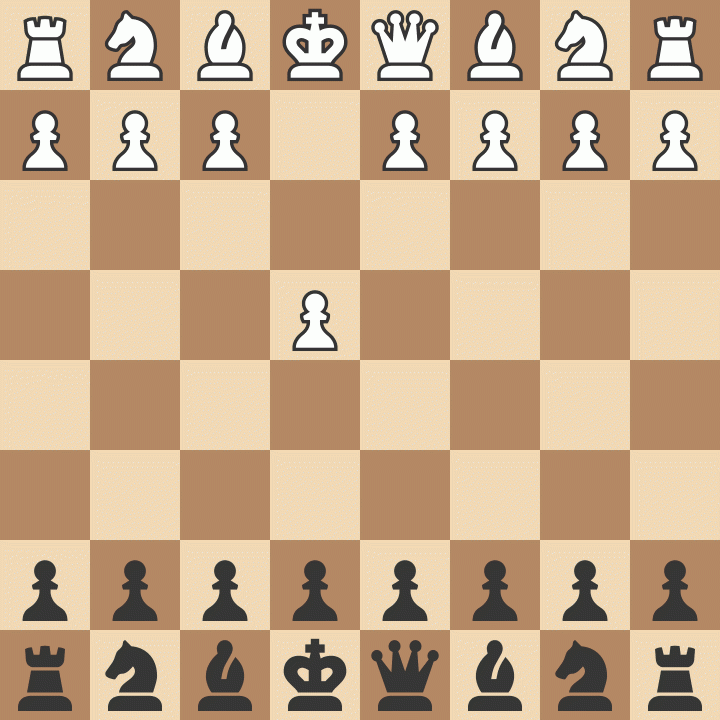
The Tübingen Gambit!
Hey Friends, It’s The Legend Vivaan! Today, I’m going to talk about Tübingen, a lovely place south of Stuttgart, which you may have heard of. Here are some fun facts…
· Eberhard Karl University is there, founded in 1477! That’s almost 550 years ago!
· Tübinger Schockoladenfestival, one of the biggest chocolate festivals in the world, happens there in December!
· You can punt on the Neckar river!
· Enjoy some history at the Hohentübingen Castle atop old town.
· Wander the Marktplatz, aka Market Square!
Now time for some chess! The Tübingen Gambit comes out of the Van Geet opening. The first moves are:
1. Nc3 Nf6
2. g4!

See how we’re offering a pawn on move two?! The beauty of this gambit is how it allows White way more development and attacking chances. Just watch… Here’s a typical progression…
1. Nc3 Nf6
2. g4! Nxg4
3. e4 Nf6
4. e5 Ng8
5. d4

Black’s knight went for a morning run, but it looks like black hasn’t even moved and white has developed a knight and got both center pawns out! Wow!
This is totally playable from here. The idea is to continue developing faster and attacking whichever way Black chooses to castle. Here’s an example of a fun game from streamer Kang Catur RV_Chess.

Note that as exciting as this opening can be in bullet and blitz formats, it’s not the best in rapid or classical because it sacrifices a pawn and the attack is not guaranteed! Note also that after 3. e4, Black has the option to play something like d6 or d5 which challenges the center and defends the Knight on g4 with the Bishop on c8.
The Dresden Opening!
Hallo, everyone! It’s me, The Man Benji! Today, I’ll be talking about the Dresden Opening.
Dresden, situated on the River Elbe, is the capital of the German state of Saxony and the 12th most populous city in Germany! If Berlin is a green city, with a third of it covered with parks and forests, then Dresden is super-duper-quadruple green, with around 62% of it covered by nature reserves and forests. It’s one of the greenest cities in all of Europe!
However, if you check out the Dresden Chess Opening, it has not green but blue vibes, because it’s similar to the Whale Opening, which I previously covered in our blog post Chess Zoo Part I.
The opening starts like this:
1. e4 e5
2. Nf3 Nc6
3. c4
As you can see, with pawns on e4 and c4, White has achieved the Maróczy Bind setup:

With the move c4, White puts big pressure on the d5 square, but gives up control of the d4 square, where Black’s knight is eager to jump to. Now, a lot of times, Black will play Bc5 to further secure their control on d4. No problem, White will continue developing with Nc3, taking an even stronger grip on d5. At this point, it doesn’t matter too much how Black plays, White is still going to do the same thing: push the pawn to d3, develop the bishops and castle, as shown in this gif:

Once White plays Be3, and if Black responds with Bxe3, White doesn’t care about doubled pawns, because now the file is open for White’s rook, and any invasion on the d5 square is stopped. One thing is that White never wants to initiate the bishop exchange on c5 because, after dxc5, White’s d3 pawn weakens, while the hole on d4 gets even bigger. Once White achieves the goal of Be2, Be3, O-O, the knight can plop on d5!
The Dresden Opening is very rare: it’s never seen at top levels, but, if played during casual chess, could be a good surprise weapon.
The Leipzig Gambit!
Since we are still in Saxony, I figured it would be the perfect time to take a 90-min drive to Leipzig to check out the Leipzig Gambit! Leipzig is the biggest city in Saxony and Germany’s 8th most populated city. It is home to one of the oldest universities in the world, Leipzig University, founded in 1409!
The Leipzig Gambit is also known as… the Halloween Gambit! Oh, the spooky times we live in!
The game starts with...
1. e4 e5
2. Nf3 Nc6
3. Nc3 Nf6, your usual 4-knights development, then, ba-a-am!
4. Nxe5!?

A favorite in chess clubs in Leipzig in the 1880s, this gambit was once described as the opening "to wake up ghosts in the sleepy Four Knight's Game." White’s seemingly gives up the knight to expand their chances in the center. Black has to accept the gambit.
This may seem a bit dubious for White, right? Right! Even the engine’s evaluation is -2.2, in Black’s favor. However, we are not computers. We’re still humans, last time I checked (unless we turned into ghosts after seeing this opening). The positions that usually arise from this gambit are very tricky, and, in the LiChess database, the win rate for White is just above 50%! The game may proceed with:
4. …Nxe5
5. d4 Ng6
6. e5 Ng8, where White is pushing the knights away from the center:
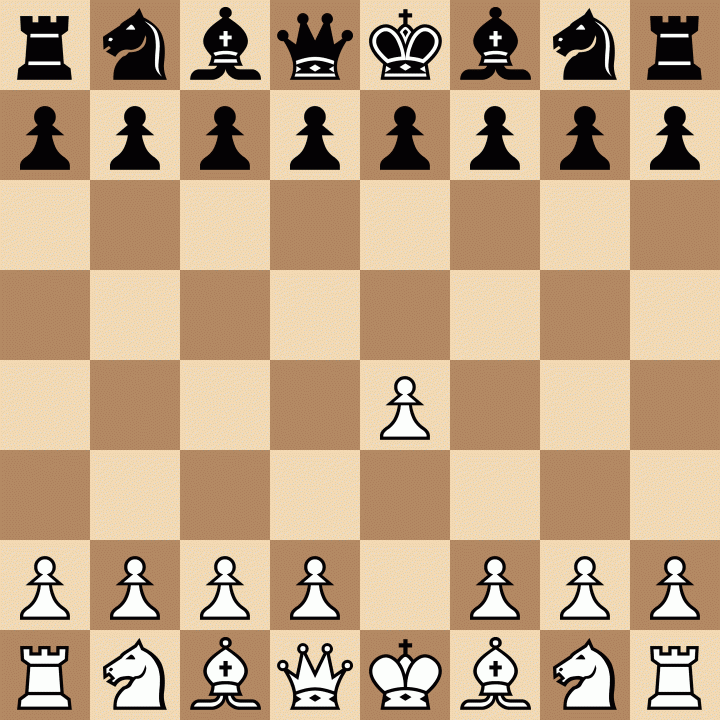
Even though White is down a piece, just look at this position. So much space and activity! Black is winning, if played accurately, but it could be hard to hold. White has many possible ideas, one of them being Qf3 and Bc4, and Black has to scramble to defend f7 square!
If you want to surprise your opponents in your casual games, try the Leipzig Gambit on any day, but if you want to scare your opponents, play the Halloween Gambit on October 31st! Mwah-ha-ha!
We can’t finish our German chess blog without mentioning some of the greatest German players. Here are a few German Chess Legends!
Karl Ernst Adolf Anderssen! The most romantic player of all time, Adolf Anderssen dominated the chess world scene in the 1850s and 1860s, even though his main focus was teaching math full time! Besides being brilliant in chess, he was a gentle and beloved soul, and perhaps because of that, people awarded his best games the most romantic names: The Immortal Game and The Evergreen Game. Below is the final position of the Immortal Game. How often do you see that: giving up two rooks plus the queen, to deliver a checkmate. Beautiful, isn’t it?

Of course, we can't forget Dr. Emanuel Lasker, who, even to this day, still holds the records for the longest reign as the Chess World Champion, from 1894 to 1921! We talked about him in our blog post on Executive Chess, first published in the Northwest Chess magazine!
Fast forward to the present day, we want to give shoutouts to...
GM Elisabeth Pähtz, the first German woman to earn a GM title! That's right!
GM Vincent Keymer, who recently established himself as the 4th highest-rated chess player in the world, let's goooo!
GM Matthias Blübaum, who recently qualified for the 2026 Candidates, congrats!
With that, Auf Wiedersehen! We hope you enjoyed the trip to the German chess scene!
Three Cheers, Fellow Future Master Chess Friends!
The Man Benji, The Myth Sarang, The Legend Vivaan


Comments