Chess Resolutions
- Jan 15
- 9 min read
Howdy! It's the Chess Friends!
We hope you are enjoying the calendar beginning! Have you set a goal or two for the new year? Today, we would like to reprint (with permission) the article we wrote for the January issue of Northwest Chess magazine, where we share our P.E.S.H.K.A. method for setting and achieving goals! We hope you find it helpful!

Howdy! It’s the Chess Friends!
Happy New Year, everyone! January 1st always feels like a fresh start… Like taking a first step in fresh, crunchy snow. You unpack your daily chess puzzle calendar on your desk, thinking… “This is it. This year, I’ll definitely solve a puzzle every day!”
New Year’s Resolutions are popular among people all over the world. Exercise more regularly… Eat healthier… Read more… But the hard truth is around 80% of people abandon their goals by 19 January! After not even three weeks! How crazy is that?! The snow melts, daily responsibilities take over, priorities shift, distractions pile up, and the goals feel unreachable without a plan.
What about the other 20% who keep going towards their goals? What about the 9% who actually stick to their goals and complete them? Their secret: they know how to set the right goals! You may have heard about the S.M.A.R.T. goals framework (Specific, Measurable, Achievable, Relevant, and Time-bound goals), which is a classic concept on goal setting, first introduced in the 1980s. There is actually a whole theory developed and tested around goal settings, and the Internet is full of advice on how to stick to your goals.
In this article, we want to share our own goal setting theory, developed last year when we worked on our book. We hope it can help you on your journey toward achieving your New Year resolutions! We call our process… P.E.S.H.K.A.! When you set your goals, try focusing on:
Process
Experimentation
Specificity
Hard work
Kindheartedness
Ambition
Last year we had an Ambitious goal to write a book. Early on, we narrowed down the ideas to a Specific topic and book format, and established our Process to write consistently. We wrote and met every week, and, after four months of Hard work, had the first draft! We Experimented with our writing style, and with the book’s title and layout, and we were always Kind to each other by listening when we disagreed. With the power of friendship, hard work, and dedication, not only did we publish the book, but we also got much better at writing, had fun with friends, and made many new ones!
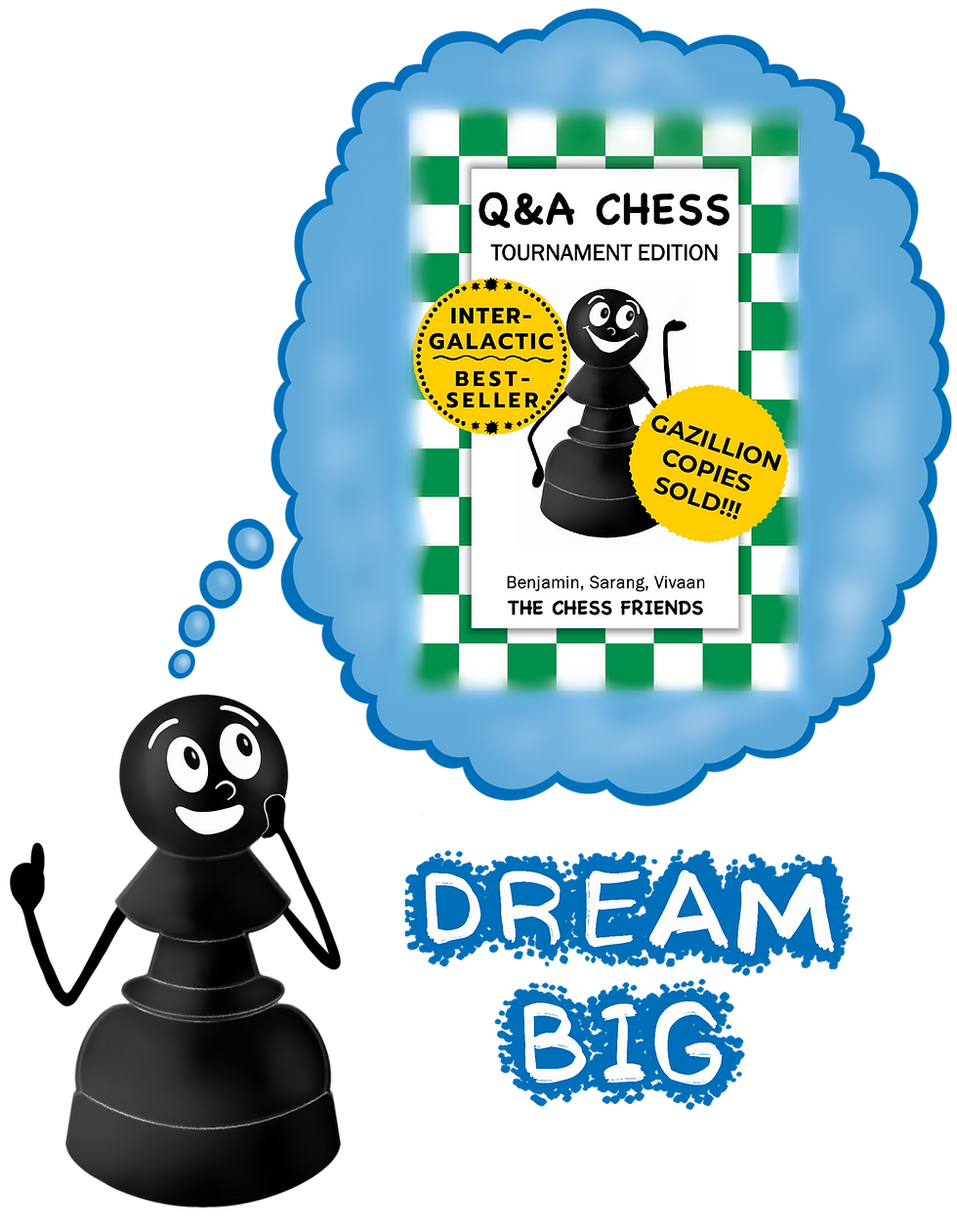
Now we would like to look ahead, and share our personal goals, chess and otherwise, and how we might use P.E.S.H.K.A. to help us reach them. As usual, our friend, Peshka the pawn, joins the discussion to remind us to dream big and focus on the process rather than the results. Peshka shares its own goal, inspired by the quote of American author of positive thinking, Norman Vincent Peale: “Shoot for the moon. Even if you miss, you’ll land among the stars.”
The Myth Sarang
Become Arena International Master (AIM) as soon as I can!
Finish Precalculus and begin Calculus by the end of 2026!
Here’s how I plan to use P.E.S.H.K.A. to achieve my goals.
PROCESS
My chess goal is to earn the AIM (Arena International Master) title ASAP, which means maintaining a high rating on FIDE Online Arena in 50 games of rapid, 100 games of blitz, or 150 games of bullet. To get there, I am focusing on consistent daily training (openings, master games, tactics, endgames, etc.), sharpening my brain, and building habits around reviewing my games. So far, I have already achieved the AFM (Arena FIDE Master) title and, before that, the ACM (Arena Candidate Master) title. Next up for me is AIM, followed by AGM (Arena Grand Master), but I will have to improve considerably to reach those levels.
EXPERIMENTATION
A big part of my journey to AIM is experimenting with my openings and training instead of thinking that one fixed routine will always work. I usually treat my studying like a series of small experiments: I try something for a week or two, see how it affects my games and rating, then decide whether to keep it, tweak it, or replace it. This method helped me choose what my main openings were!
SPECIFICITY
As I said before, you can play 50 games of rapid, 100 games of blitz, or 150 games of bullet to get the title. I chose 100 games of blitz initially because it is usually what I play online, and that quickly got me the ACM title. Then I transitioned to 150 games of bullet and that helped me reach the AFM title. It was fast, fun, and I got many reps to practice my ideas. It’s also the most popular time control, so it is more than likely I get games fast. We will see what time controls I use to pursue AIM, probably a combination of all of them!
HARD WORK
My other goal for this year is to finish Precalculus by the end of the year. Finishing Precalculus is not just about talent, it demands consistent hard work. For me, hard work means showing up even when I’m tired or not fresh-minded, and still doing my equations instead of skipping days. I do math lessons with my dad multiple times weekly and work on math websites every weekday. As for chess, yes, I play online and study the game daily.
KINDHEARTEDNESS
Kindheartedness in my AIM journey means practicing good sportsmanship online, like on some websites disabling chat to avoid mean comments, never raging after a bad loss, and keeping a growth mindset. By prioritizing kindheartedness online, I create a cycle of positive experiences that boosts focus and makes the grind toward AIM enjoyable. I’m also kind to myself because I know it’s a journey that’ll have ups and downs, and, as long as I enjoy the ride and keep seeing growth, it’s bound to happen.
AMBITION
Ambition powers my goal of AIM a lot. I’m not just playing for fun, I’m entering large daily arenas, targeting consistent performances against strong players, and holding that high rating threshold without dipping below. It is also ambitious in that my first iteration of FIDE Online Arena got me to ACM, and the most recent cycle of games got me to AFM, but I haven’t been able to come too close to the threshold required for AIM yet. That said, I still believe in myself and know I can get that AIM.

The Legend Vivaan
Become a FIDE Master (FM) (2300) when I’m 10!
Invent teleportation!
For me, the three things in P.E.S.H.K.A. I’m really good at are Ambition, Experimentation, and Process. My goals are super-duper ambitious. I may be a 1500 7-year-old, state and national champion, but getting FM at 10 is very difficult, but I believe in myself! Teleportation is something we see in movies and that’s about it. People have tried to invent it but no one has ever succeeded. I will do it. That is ambitious.
Process for me is how I can work toward my goals. I come up with new inventions every day and practice being creative and thinking outside the box (well inside the box if you call my house a box haha). As for the FM goal, I study and play chess every day. I experiment a lot and always try to learn from my experiments, and keep working hard to get better. I would encourage you all to dream big, and even if you don’t reach the ultimate goal, you will grow and achieve many smaller goals along the way!
The Man Benji
Become a National Master (NM) (USCF 2200) by the end of 2027!
Do 50 push-ups in a row by the end of July 2026!
Before embarking on the journey to reach your goals, you need to know: Why these goals exactly? Why are they important to you? To answer those questions, you need to imagine your future. Where do you see yourself in two, three, or even twenty years from now?
I close my eyes and see myself as a GM, but the image is a bit hazy; it’s too far into the future. GM is my ultimate goal that can be achieved if I have a few checkpoints along the way, like my current goal of becoming a National Master. The other current goal, being able to do 50 push-ups in a row, is a smaller goal too. The ultimate goal, or the reason behind this goal, is to get stronger so I can help my volleyball team have more success.
This is how I’ll achieve my goals with P.E.S.H.K.A.!
PROCESS
I’d like to become a National Master as soon as possible, but I know it’s a long journey that requires discipline and a well-thought-out process! Each day, I’ll find 2 hours just for chess: 30 minutes of puzzles, 30 minutes of opening or endgame practice, 30 minutes of looking at master games, and the rest of the time playing blitz or rapid and analyzing. My first checkpoint is getting CM (Candidate Master) at 2000, and then I’ll make my way to 2200 and the NM title!
EXPERIMENTATION
I also have a fitness goal: Do 50 push-ups in a row by the end of July 2026. A big factor that can help me achieve this goal is by not staying fixed on one type of push-up all the time, but instead try something new. For example, I could try a clapping push-up, or even try switching to a few sit-ups instead. As for my chess goal, in my games, I will try something new and unusual to practice different ideas and be ready for anything. Too much experimentation might be bad, though. It can take you on a detour, which might be scenic, but could distract you from your main goal.
SPECIFICITY
In my chess goal, I said I was going to train 30 minutes of puzzles. 30 minutes?! The average time it takes to solve a puzzle is 30 seconds! That means I’ll complete 60 puzzles in one sitting! No, that’s not really how I’m going to do it! Instead, I’ll spend about 5–10 minutes for each puzzle, taking my time to write down ideas and my thought process in my chess journal. That way, instead of rushing carelessly through each puzzle, I’ll build up my logic and reasoning in different types of positions!
HARD WORK
Like Peshka showed here, you have to work hard. There’s no way around it! You have to take steps towards your goals every day. Even in days when I feel I don’t have the strength, I still have to push through that feeling and go through my process. Why? Because my goal and my future self motivate me.
KINDHEARTEDNESS
I have to be kind to myself. When I’m getting to my limits, I stop, so my body and mind have a chance to recover. Having a good night’s sleep means being kind to yourself. When I’m solving a chess puzzle or playing a game and I lose, I don’t get mad at myself or my opponents. Instead, I think to myself that my opponent played a great game and then analyze where I went wrong.
AMBITION
Ambition is wondering how much I can achieve when I stay true to my goals. I want to see where this journey can take me. Ambition is the rocket that will take you to the moon or to those coveted chess titles! Dream big!

Here's a summary of some takeaways to help you achieve your resolutions.
The Chess Friends Tips to Setting and Achieving Your Goals
· To be more organized and accountable on your journey to your goals, every day make a plan, and celebrate smaller goals achieved along the way!
· Dedicate yourself to your goal. Really mean it. Even if you feel a little blue today, challenge yourself! One of the best swimmers, Michael Phelps, once said “There are going to be some days when you don’t feel like training, it’s what you do on those days that matter.” It doesn’t have to be much, but consistent practice goes a long way.
· Sometimes, less is more and more is less! Instead of trying to cram everything into one sitting, spread it out and give yourself some breaks! Every day, strive to take at least one step toward your goal. If you don’t have time to do 10 chess puzzles, do one or two. It still counts.
· Remember: “A happy mind is a healthy mind.” Every day, express your gratitude toward life. Sometimes, we get lost in what we’re doing and forget how to live happily.
· Be kind to yourself. Be kind to others. Sometimes, we get frustrated that something isn’t working out, but that’s no reason to rage or complain. Even the greats make mistakes. It’s how you learn from those mistakes that will help you grow.
· Don’t be afraid to adapt your process. One of the greatest ways to learn is to experiment with many things, do enough of each to know whether or not it’s right for you, don’t be afraid to fail, learn from those failures, and run with what works best for your growth.
· Never compare yourself to others. Compare your current self to your past self. Growth is personal, and it’s critical that you run your own race.
· Be ambitious. Trust your process. Work hard. Experiment often. Anything is possible when you set your mind to it, but don’t let yourself be disappointed if you don’t reach your ambitious goals in the time you want.
We hope you find this helpful and have fun reaching your own goals! We are rooting for you!
Three Cheers, Fellow Future Master Chess Friends!
The Man Benji, The Myth Sarang, The Legend Vivi


Comments