Chess in France, oh là là!
Howdy, it’s the Chess Friends!
Bonjour! Once again, we welcome you aboard Chess Friends Airlines flight, this time with service to France! Sit back, relax, grab a fresh and flaky croissant, and enjoy a smooth, turbulence-free journey through the history of French chess, the country’s brilliant chess players, and the contributions they made to the game!

The Man Benji
Philidor: the Age of Enlightenment
Salut! It’s the Man Benji! Today, we will start our journey through the French chess history in the Age of Enlightenment, aka the Age of Reason, a period from the late 1600s to the 1800s when big advances in science, philosophy, and culture happened, and chess was right in the middle of it all!
One of the greatest innovations of that time was the establishment of coffeehouses, where people would gather to exchange ideas and play chess--something that we all are still enjoying today!
In Paris, the most famous coffee house was Café de la Régence, opened in 1681, and many strong chess masters came there to challenge each other! From Benjamin Franklin to Napoleon Bonaparte, from Paul Morphy to Stamma, everyone would come to soak in all the chess action, with very serious matches taking place.
In the early 1700s, the strongest player in the Café was François Antoine de Legall de Kermeur, who we now know as Legal. Lots of players from around the world would travel to Paris to challenge him. He won against them all, and he did it in style! His famous contribution to chess is the Legal’s Mate, where he sacrificed his queen in the opening to deliver checkmate with two knights and a bishop. Here it is below, thank you chess.com for the gif!

Once, on another regular day in the Café, when Legal was winning all his games as usual, he played against a teenage boy and also won that game easily. Despite his cruising win, Legal saw chess talent in his 14-year-old opponent and took that boy under his wing, becoming his teacher. The boy’s name was François-André Danican Philidor.

Philidor came from a family of musicians and studied music, composing operas at the age of 11! Besides music, he also enjoyed chess, and often would play games against himself in his mind!
After meeting Legal, Philidor started working really hard on his chess, further developing his calculation, visualization, and checkmating skills. After five years of steady improvement, Philidor finally won against his teacher Legal to became the strongest player in France.
Philidor continued his chess and musical careers, traveling around Europe to perform both. More often than not, playing chess would bring more money, which he used to finance his musical career.
Philidor wrote an important book on chess, Analyse du jeu des Échecs, where he not only showed endgame puzzles and opening studies, but also analyzed games from start to finish, spending more time looking at middlegame and talking about positional play. The book was so important that it saw 70 editions and was translated to many languages!
Philidor was one of the first players who understood the true value of pawns. He even stated "Les pions… ils sont l'âme des Echecs" ("Pawns are the soul of chess”).
Our Peshka couldn't have said it better!
Philidor came up with many chess ideas during his life: a checkmate pattern, many endgame positions, and even an opening. Wow, if someone invented that many chess ideas in the present, they would win a Chess Nobel Prize or something!
Let’s start with Philidor’s Mate, also known as Smothered Mate! It’s one of the first ever patterns we learn as we begin our chess studies. Smothered Mate happens when your opponent’s king is blocked by all their pieces and you get to checkmate them with a knight. It starts with a position like this:
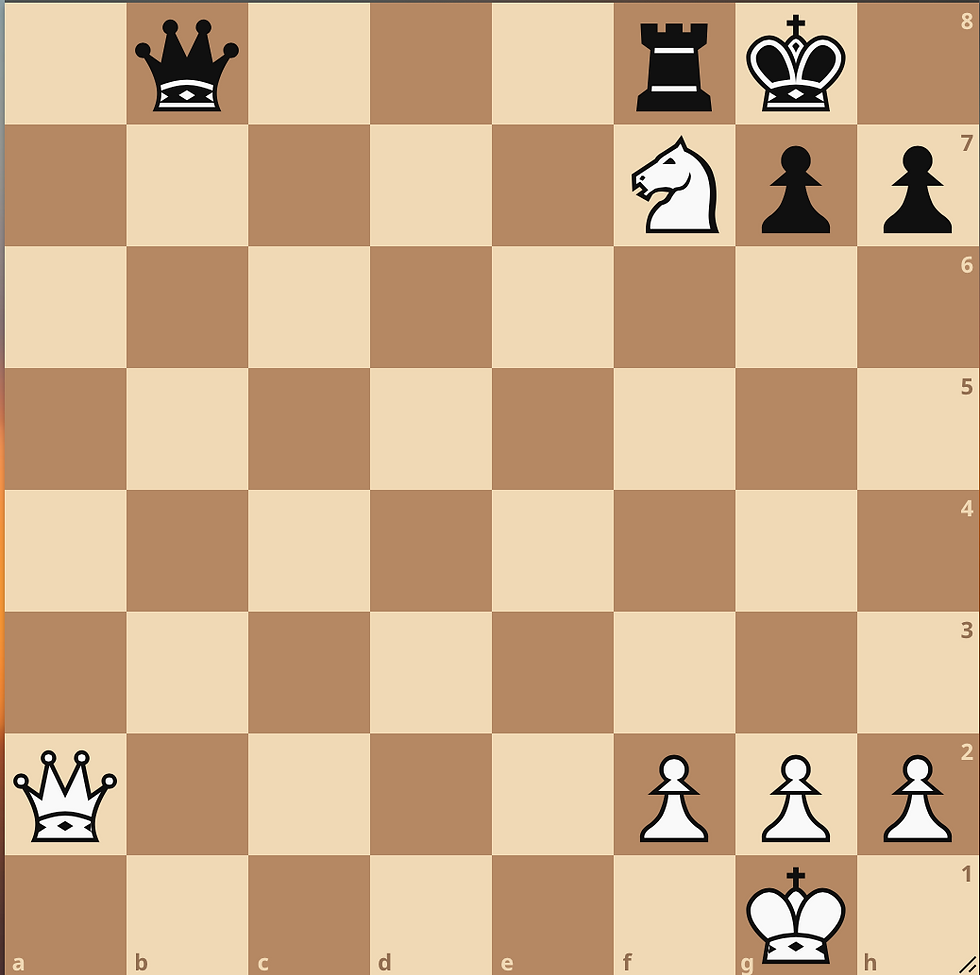
It looks like White’s position is lost: down an exchange, weak king, and a back rank checkmate is coming! But… Black's king is weak too, and it’s White's turn to move! The White Queen on a2 is looking right at the Black King, so… what do we do?
1. Nh6+, discovered check!! Since both White’s knight and queen are checking the Black king at the same time, they can’t block the check, so they must move 1… Kh8.
Now, we play the brilliant 2. Qg8!!, sacrificing the QUEEN! 2… Rxg8 is the only move, and now, White can finish with the prettiest checkmate of all time.
3. Nf7#

Look at how cool this final position is! White is down a queen and a rook, all they have is a knight, and that’s enough to checkmate the Black king!
Now, let’s look at the Philidor Defense, played as Black. It happens after the opening 1.e4 e5 2.Nf3
Black responds with 2…d6, which is the third most popular choice in Master games (after 2… Nf6 and 2… Nc6), and it marks the start of the Philidor Defense:

White’s best and most aggressive choice is to play 3. d4, striking in the center!
Philidor, living in the Romantic chess era where attacking chess was the way to go, suggests the move 3… f5 for Black, giving up the pawn.
Now that’s not considered the best reply as Black’s king becomes way too weak. Instead, Black should play 3… exd4, and White can either take the pawn back with the queen or the knight. I have faced a couple of weird positions against the Philidor Defense. The idea for White is to take control of active squares, while Black attacks the center and the kingside to restore balance. The Philidor Defense is definitely an interesting sideline to Black’s normal knight-developing moves.
Perhaps Philidor’s greatest contribution to chess is his endgame theory, still used today, specifically Rook endgames and Queen versus Rook endgames. They are a must-know for every chess player!
Let’s start by looking at his Queen vs Rook endgame technique, starting with this position:

Even though White has an advantage, up 4 points in material, this can still be a tricky endgame to win! The idea for White is to find a way to force Black’s rook away from their king, via a special technique called triangulation, and then win that rook via a fork.
In this position, White plays 1. Qe4+ Kg8 2. Qa8+ Kh7 3. Qe8.
Wait a minute… Did we end up where we started? Yes! But… with one important difference: It is now Black’s move! This is called triangulation, and, in this case, White forces Black’s rook off g7, cutting of its connection with the Black king. No matter where Black’s rook moves, there is a fork!
Let’s say Black plays 3… Rg1. Now we can make a fork with the sequence:
4. Qe4+ Kh8 5. Qa8+ Kh7 (if 5… Rg8 6. Qh1#) 6. Qa7+ does the job!
If Black plays 3… Ra7, we have 4. Qh5+ Kg8 5. Qd5+ Kh8 6. Qh1+ Kg8 7. Qg1+ winning the rook.
Now, let’s move on to Philidor’s next endgame technique, his famous Philidor’s position of Rook + pawn vs Rook.

This position is a draw even though White is up a pawn, and the idea is simple:
1… Rb6!
It’s magic! Despite how passive this move looks on the surface, it’s really effective as it cuts off the White king’s path to the 6th rank. If White doesn't play 2.e6, then Black will keep shuffling the rook on the 6th rank, and there is nothing White can do. If they finally push the pawn up, 2. e6, Black's Rook swings all the way to 2… Rb1 and regains activity:

Now, if White’s King advances 3. Kf6, Black starts giving checks like there’s no tomorrow, 3… Rf1+ 4. Ke5 Re1+ 5. Kd5 Rd1+ 6. Kc6 Re1 forcing White to defend the pawn. White can’t make any progress and the game ends in a draw.
If White plays 3. Rf2 (instead of 3.Kf6), blocking the check, Black plays 3… Ke7 followed by Rb5+ and the game becomes an easy draw.
I recommend to set up these Philidor endgame positions on Lichess and play against different engines as White and as Black many times, until wins and draws become walks in the park!
Now let's hear from Sarang, who will take us through “The Long Nineteenth Century!”
The Myth Sarang
French Defense
Bonjour, mes amis! C’est moi, The Myth Sarang! Today we will be studying the French Defense opening as Black.
According to our sources, the French Defense came into existence thanks to correspondence chess! Sometime in the 1830s, a correspondence match was held between the London Chess club, and a chess club in Paris. After English players made their first move, 1. e4, they received a surprising at that time response across the English Channel: 1. ... e6! That's how the French Defense, nowadays a respectable opening, came to be!
The main lines of this opening arise after the moves 1. e4 e6 2. d4 d5:

This opening has been played by many grandmasters, including legends Viktor Korchnoi, Aron Nimzovitsch, Alexander Morozevich, World Champions Boris Spassky and Mikhail Botvinnik, etc.
If you want to shut down White’s aggressive ideas early on in the game, the French is a great opening to look into, as it sets up a rock-solid wall immediately that keeps your king safe while you attack White’s center. It leads to interesting and sharp lines where you get to play for a patient counterattack instead of avoiding early traps. The only major catch is: your light-squared bishop (LSB) which I have circled immediately gets blocked behind your own pawn chain. This “French Bishop” becomes your biggest strategic issue, turning the game into a patient one where your main goal is to safely maneuver this piece while chipping away at White’s center. Some main ideas to bring this bishop out include:
b6, then Ba6 trying to trade it,
Bd7-e8-g6 sometimes eventually,
And even Bd7-Bb5 with a6 to support or even a4 in specific moments,
But with all that, the simplest way to free the bishop is if White plays 3. exd5 exd5, the Exchange, and basically you just want to play chess here. Nf6, Bd6 and Ne7, c6, O-O, Nc6, Bf5 to free our French bishop, etc. are all great developing moves.
The second main line is 3. e5, the Advance, and this line is very critical. You have to know two pawn breaks, those being c5 and f6, trying to free our pieces and destroy White’s center. These both usually happen in this variation where White is focusing on the protection of d4, with c5 pressuring White into doing so. The main line here is 3… c5, but 3…. Bd7 is also fine with the idea to trade the bishop early with a6 and Bb5, except in that line there’s not usually f6 and it’s usually Ne7-f5 then an attack by bringing the rooks over and going g5 and h5.

Here’s a position that can happen out of the Attack variation with 3… Bd7. Black is threatening to attack with g4 and h4, and deflecting the knight from defending d4 so we can capture with ours. The attack is raging, and Black is better.

And here’s something that comes out of the mainline with 3… c5, where White has an IQP (Isolated Queen’s Pawn) and our LSB can get in the game like this. We have lots of active pieces, and Black has the advantage here.
There is also the Classical Variation with 3. Nc3, where Black can play the complicated Winawer with 3… Bb4, the attacking 3… Nf6 Steinitz Variation with ideas to retreat Nfd7 after e5 then c5 and f6 pawn breaks just like the Advance, and the Rubinstein Variation 3… dxe4, where Black can play ideas such as Nd7, Ngf6, Be7, and developing the French LSB with b6 and Bb7, fianchettoing. These are all great main lines and I recommend studying whatever looks good to you. If you like complicated, tactical, sharp play, consider playing the Winawer. If you like positional pawn breaks and counterattacking chances, try out the Steinitz. If you want to play something really simple, the Rubinstein is for you!
The Tarrasch Variation comes after 3. Nd2, and is a great French counter. The best moves after this include 3… c5, aiming for d4 and a pawn break with the idea of 4. c3 cxd4 5. Cxd4 dxe4 6. Nxe4 creating an IQP and a weakness for White, 3… dxe4 whereafter 4. Nxe4 it transposes into the Rubinstein lines for very easy play. 3… Nf6 has some of the same ideas as the other line with Nfd7, c5 and f6, looking for pawn breaks.
I highly recommend this opening to anyone who is up for complex, counterattacking play!
Before switching gears to some current chess in France, let's talk about FIDE, the Fédération Internationale des Échecs, also known as the World Chess Federation. FIDE was formed during the first Chess Olympiad during the Summer Olympics in Paris in 1924. The motto “Gens una sumus” means “We are one family”. FIDE was founded on July 20th, which is celebrated annually as International Chess Day. FIDE is responsible for rating many tournaments, running Olympiads and the World Championship, providing rules, and awarding titles.
Soon after FIDE was established, in 1927, Russian-born French player, Alexander Alekhine, challenged the third world chess champion José Raul Capablanca for the World title.

After a grueling championship that lasted 6 months, Alekhine became the new chess champion of the world! In 1935, he was defeated by Max Euwe, a shocker at the time, but easily regained the title back in 1937, holding it until his passing in 1946, becoming second (only after Emmanuel Lasker) for the greatest number of years as World Champion!
I would recommend any chess player to look at Alekhine's games since he was a versatile player, knowing how to slowly build an advantage, and when to unleash the attacking tactics. He even has a cool idea named after him: the Alekhine's Gun, every player's dream!
This is a position where you take control of a file, lining up both of your rooks and the queen, like in this original game where Alekhine first employed this idea:
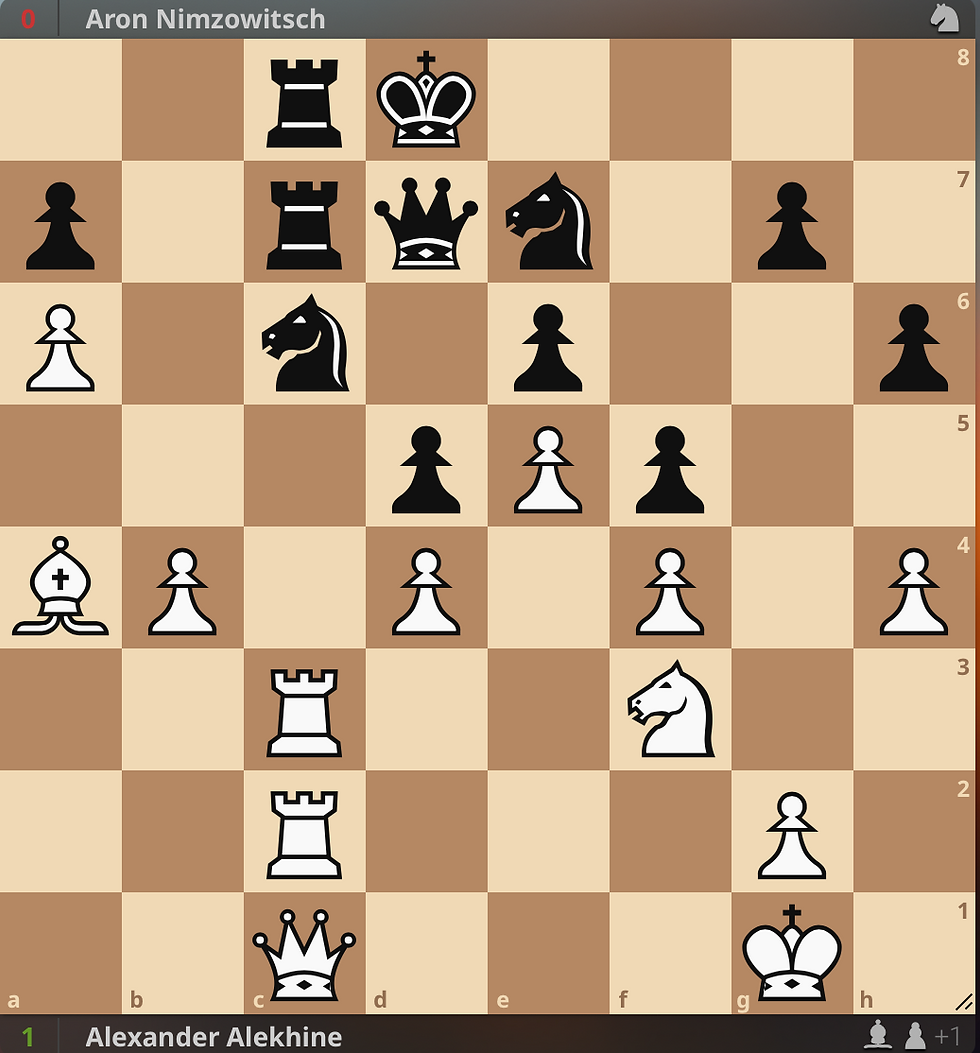
In this game, from 1930 in San Remo, Italy, Alekhine, playing against Aron Nimzowitsch, patiently configured his rooks and queen into a single file to unleash the attack. Seeing this formation, Aron resigned. Check out the full game here.
And also, check out the opening that Alekhine popularized, which now carries his name, the Alekhine's Defense. What's a better way to learn the opening than from the master himself? Look at the game here!
Now setting the stage for Vivaan!
The Legend Vivaan
Chess in France: Modern Times!
Howdy! It’s the Legend Vivaan here!
France is legendary at chess tennis, a combination of two of my best sports! Sebastian Mazé has 4 world championships and Laurent Fressinet has 1 world championship! You can read more about chess tennis on our earlier blog here: Boxing, Diving, and Tennis… Chess!!!
The best current chess players in France are Super GMs Maxime Vachier-Lagrave and Alireza Firouzija, who switched from the Iranian federation.
Maxime is a former world junior champion, two-time European blitz champion, and has a peak classical FIDE of 2819, second only to Magnus Carlsen in August 2016. He was world #1 in Rapid and Blitz in November 2019, with peak FIDE Rapid rating of 2873 and peak FIDE Blitz rating of 2948!
Alireza’s broke Magnus’ record as youngest to reach 2800 at 18. Magnus called him future world champion. We’ll see if that happens! He peaked at World #2 behind Magnus in December 2021. He is considered by many to be the best Bullet chess player in the world, winning the Bullet World Championship in 2021, 2024, and 2025, including several wins over Hikaru Nakamura, who many consider the bullet #goat.
In 2025, Alireza played a spectacular game vs Maxime at the SuperBet Classic in Romania, part of the Chess Grand Tour. Firouzja Alireza vs Vachier Lagrave Maxime - Grand Chess Tour: Superbet Chess Classic Romania 2025 - Chess.com

Maxime played 43… Bc8, and as you can see chess.com gave that a ?? Do you see Alireza’s brilliant move 44 earning him a !! ? There’s a long sequence of sharp moves that follow it as well, which I’ll mention here.
Are you ready for this?!
44. Nxd5!!
Alireza is sacrificing his knight for a crazy attack that’s actually completely winning. The game continues with 44… exd5, 45. Qxa7+ Bd7, 46. Bxd5+ Nxd5, 47. Qxd7+ Ne7, 48. Rf5+ Rf6, creating the White-to-move position shown below:

In this position, Alireza finds another !! brilliancy! Do you see it?
49. Rxg4!!
This move is bananas but it works! The idea is if 49… Qxg4 then 50. Rxf6+ Kxf6, 51. Qxg4 winning the Queen!
Maxime saw this and played 49… Qh8, to which Alireza responded 50. Rxf6+ Kxf6, 51. Rh4 and at this point Maxime resigned. Even though White is still down a piece for two pawns, there is nothing Black can do in this position. The engine actually has Black’s best move here as sacrificing their Queen for the Rook, which is losing, because otherwise White has threats like Rf4+ and many mating lines that follow. Find a board and play it out if you can! What a spectacular game by Alireza!
We hope you enjoyed this chess journey through France, and will come back again for more chess world adventures with your trusted Chess Friends Airlines!
Three Cheers, Fellow Future Master Chess Friends!
The Man Benji, The Myth Sarang, The Legend Vivaan


Comments