Opening to Italy
Howdy! It’s The Chess Friends!
Less than a month ago, Alaska Airlines introduced the first ever direct commercial flight from our city, Seattle (SEA), to Rome (FCO). Learning that made us think about Italian chess… and Italian food… Yeah, pizza sounds good!

We're sorry we can’t deliver Italian pizza to you or give you a ticket to Rome! Instead, we'll take you on an epic chess journey to Italy for free! Welcome to The Chess Friends Airlines, where we will fly over the history of Italian chess and its openings! Captain Peshka at your service!

There is such a rich history of chess in Italy that has changed the way we think about, interact with, and talk about it: “Fianchetto that bishop!”

Wait, that’s not the bishop yet! It is still an elephant chess piece, from the Charlemagne chess set, believed to be made in the 11th century in Salerno, 70 km south of Naples. Legend has it that the set belonged to Charlemagne (748–814), an Emperor in Europe, but it’s only a legend because the dates do not add up.
Italy is filled with legends. How it could not? Just look at this setting:

This is in Marostica, a small town about 80 km north of Venice, known for its Living Chess Game. Every other year in September, people gather on this square to watch or to be a part of the chess game taking place right there, under the sky, with real humans and real horses as chess pieces. Legend has it that in 1454 two talented noblemen met on the square and played a chess match to determine who would marry the daughter of the local lord, rather than dueling. Nobody got hurt, and the story has a happy ending, but you have to go to Marostica yourself this September to see this traditional chess match unfold, and, while there, you can stop by Italy’s first International Chess Museum, which literally opens this weekend!
Maybe The Chess Friends could sponsor your trip, after the millionth copy of Q&A Chess gets sold! You could speed up the process by buying the book now for yourself or as a present for a friend!
Did those wise noblemen from Marostica played the Italian Game in 1454? Let’s hear from The Man Benji.
The Italian Game
The Man Benji
Buongiorno! It’s the Man Benji!
Le presento Giuoco Piano, one of the oldest analyzed chess openings, also known as The Italian game. Still in fashion, still played at all levels, it is one of the best openings to start your chess journey!
Who was the first to play it? We don’t know! But it was the chess player Pedro Damiano (1480–1544) who was first to write about it! Damiano was originally from Portugal, but he settled in Rome (I love Rome, so kind of understand him!), learned the Italian language, and wrote a chess book!

Published and republished, the book became a bestseller! It provided new chess enthusiasts with basic rules, advice, and chess puzzles. Pedro claimed that the only two good opening moves for White were e4 and d4, and Black had to respond symmetrically: playing e5 against e4 and d5 against d4. One of the openings he described was the Italian, which was also called The Giuoco Piano, meaning The Quiet Game.
Don’t be fooled by a quiet name of this opening, though! Yes, while some of its lines can lead to “slow build-up” positions, there are other lines that call for tactical sharpness and precision, such as those, for example, that were analyzed by another brilliant Italian player and the world chess traveler, Gioachino Greco, in the early 1600s.
The classy Italian game begins with:
1.e4 e5 2.Nf3 Nc6 3.Bc4 Bc5

After that the most common move is 4. c3, and Black will answer with 4… Nf6.
Here White has two options. One is to play 5. d3, which is called The Giuoco Pianissimo, meaning really-really quiet game, where White would eventually go for a queenside attack via b4-a4-a5.
The more exciting move is 5. d4!, immediately striking in the center. Black will play 5 … exd4, the only good move. White takes d4 back with 6. cxd4, the most common move, attacking Black’s bishop.
Black has to postpone their development and save the bishop! But they have to do it in the most forceful way to save time or else their position will get blown up before their king is even castled. So, Black plays 6 … Bb4+.
For White, it doesn’t matter which way to block the check, but 7. Nc3 is the most common at the beginner level.
Wait, what? Look at this position, White’s knight on c3 is pinned to the king and cannot defend the e4 pawn! Did White just give up a pawn for free? 7… Nxe4:
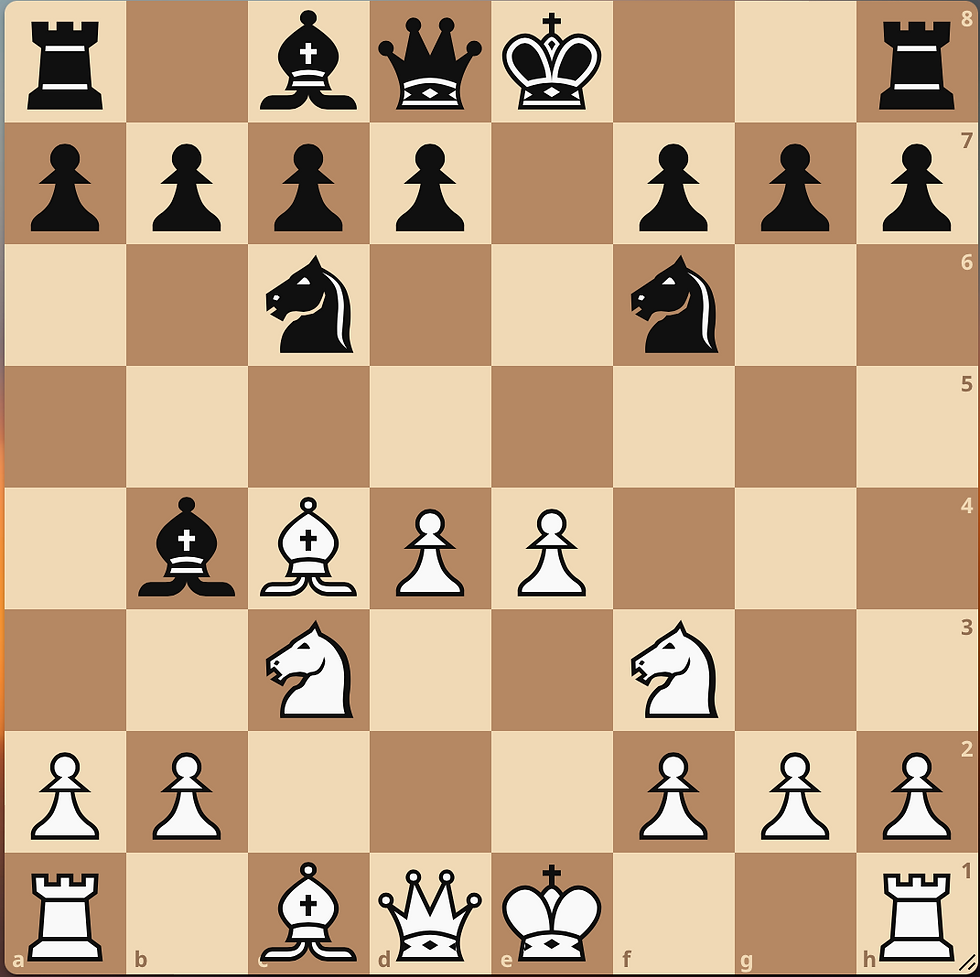
Yes, they did! It’s the Greco Gambit! White has big compensation; let me show you.
White just calmly castles 8. O-O, and Black has to do something about that knight on e4. Nothing defends it from the White’s knight attack! So, Black removes the White knight with 8 … Bxc3 (more popular way).
If you want to create maximal chances in this position as White, do not retake the Black bishop!
Play 9. d5! to attack the other knight.
Here, Black has two moves: retreat the bishop (Bf6) or save the knight (Ne5).
Let’s look at 9 … Ne5. White then retakes the bishop, thank you very much (10. bxc3), and Black will take the hanging bishop 10 … Nxc4.
Ooof! White sacrificed not only a pawn but a whole Bishop! Where is White’s compensation?! Better piece coordination? An attack on the Black king still in the center?
Yes! But first things first. Let’s retake our piece. White plays 11. Qd4, attacking both knights. Which one does Black want to save? Awkward!

It’s easy for Black to go wrong. If they try to save both knights by playing 11 … Ned6, it’s a huge mistake! 12. Qxg7! wins: no way of saving the rook and avoiding checkmate.
Better (but not the best) for Black is moving the other knight to d6: 11 … Ncd6,
From now on, it’s an even game, but Black has to be careful! Here is how to proceed: 12. Qxg7 Qf6 13. Qxf6 Nxf6 14. Re1+ Nfe4 15. Nd2 attacking Black’s knight. Remember, it’s pinned to the black king, so after 15… f5 white can play 16. f3 winning that knight back.
Here is a GIF showing all this (thank you Chess dot com):

It becomes an endgame where only White plays for the win, and there are some chances for Black to go wrong. I mean, their queenside is not even developed yet!
Note that instead of saving the knight on move 11, Black’s best bet is to quickly finish development, maybe castle (11… O-O), then it becomes anyone’s game. I would recommend you to analyze this part yourself. I’ve been on the Black side of this, and the positions can get crazy! It would take many more blog posts to analyze the rich Italian Game!
For now, let’s hear from The Legend Vivaan, who sails to Sicily to talk about another Italian chess gem!
The Sicilian Defense
The Legend Vivaan
Howdy Friends! It’s the Legend Vivaan!
My favorite Italian food is pasta! Which one? Honestly, I like them all, especially with a good pesto sauce!
Today, I’m going to tell you about a legendary opening that came from Italy in the late 16th century: The Sicilian Defense. Sicily is an island in the Mediterranean Sea, South of Italy. Did you know that sometime in the 20th century, the Sicilian Defense, namely 1… c5 in response to 1. e4, became the most played chess defense as Black at the top level, replacing 1… e5? Amazing.
Let’s start with some history. Giulio Polerio wrote about the Sicilian Defense in a manuscript in 1594, and other early enthusiasts were Allesandro Salvio, Don Pietro Carrerra, and Gioachino Greco. In the late 18th century, French Master François-André Danican Philidor championed the defense. In the late 19th century, Masters like American Paul Morphy, Bohemian Wilhelm Steinitz, and German Siegbert Tarrasch said the Sicilian wasn’t good, so it became less popular, for a while.
It wasn’t until later, in the 20th century, when World Champions American Bobby Fischer, Soviet Mikhail Tal, and Russian Garry Kasparov played the Sicilian, that the defense rose in popularity. The reason it’s become so popular today is that it gives Black real chances to fight for a win, rather than just equalize, like many other openings. It avoids symmetry and creates complex dynamic positions early on by challenging White’s center control.
There are lots of variations of the Sicilian defense. Some popular ones include the Najdorf, Dragon, Sveshnikov, Scheveningen, Kan, and Taimanov. When I play the Sicilian, not my main opening response to 1. e4, I usually opt for the Taimanov or Dragon.
The Sicilian Najdorf is probably the most played Sicilian at the top level today. It goes 1.e4 c5 2.Nf3 d6 3.d4 cxd4 4.Nxd4 Nf6 5.Nc3 a6… Shoutout again to Chess dot com and Lichess for helping us prepare the gifs and photos in this blog.

I really like the Najdorf because a6 prevents Nb5 or Bb5 and allows Black crazy counterplay with b5 ideas as well as potentially castling queenside.
I don’t want to go into too much depth here so let’s just show you one more, and one I’ve played in tournaments before, the Dragon: 1.e4 c5 2.Nf3 d6 3.d4 cxd4 4.Nxd4 Nf6 5.Nc3 g6.

Even within the Dragon, there are accelerated and hyper accelerated versions, but here are the general themes. The idea is to is fianchetto your dark squared bishop on g7, castle kingside, and have great counterattacking potential on the queenside.
Now I’ll turn it over to my big bro The Myth Sarang, who’ll discuss a pretty great opening for White that also came from Italy, namely the Ponziani!
The Ponziani Opening
The Myth Sarang
Ciao! It’s the Myth Sarang! My favorite Italian food is all the Antipasti, namely appetizers, but especially Bruschetta (pronounced broo-sket-tuh).
Today I will be covering the Ponziani Opening, named after Italian law professor, composer, theoretician, priest, and chess player from Modena, Dominico Lorenzo Ponziani (1719–1796). In my opinion, this is the best chess opening for beginners for White (The Italian Game that The Man Benji covered is equally good) and has many extremely vicious traps that you can use to crush your friends. Without further ado, Andiamo!
This opening begins with the most popular first moves: 1. e4 e5 2. Nf3 Nc6; then we as White will play the fifth most popular move here in this position (3% of games in this position go like this based on current Lichess data), 3. c3. This is the initial position of the Ponziani.

Our idea here is to play 4. d4 on the next move to control the center and get a good position. Black plays 3… Nf6 and attacks our e4-pawn, the most popular move in around 50% of games. We now play 4. d4, our idea to control the center of the board.
There are 2 main continuations here that make up around 90% of games from this position, namely 4… exd4 and 4… Nxe4. Let’s say Black plays 4… Nxe4 and gets greedy. We now play 5. d5! attacking the knight and hoping to take on e5 with the knight next move.
Black plays 5… Ne7, retreating the knight and attacking the pawn on d5. Lucky for us, we have a Queen defending that pawn. Now we play 6. Nxe5 and Black plays the fatal blunder, played in 60% of games, 6… d6?? This position is shown below:
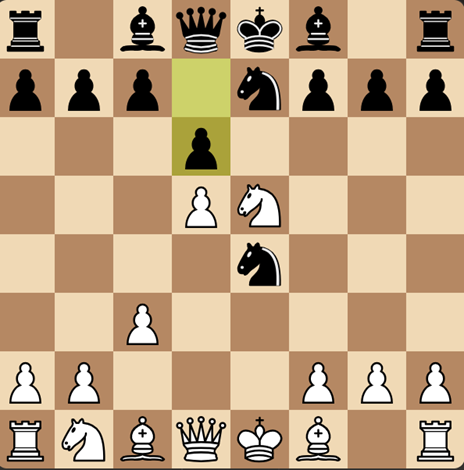
Now, as White, can you find the winning move?
Answer coming in
3,
2,
1,
It’s 7. Bb5+!!
Now Black’s only way to interpose is 7… c6, then we play 8. dxc6, then the line goes 8… bxc6 9. Nxc6 Nxc6 10. Bxc6+ and we win a rook.
There is also this really fun line where Black plays 8… Qb6. We play 9. cxb7+ and discovered check the Black King with a threat of bxa8 and promote to Queen. If Black plays 9… Kd8, we have 10. Nxf7+ Kc7 and then the absolutely brilliant move:
11. bxa8N PROMOTE TO KNIGHT!!!!!!!!!!!!!!!!!!!!!!! This wins a queen on the next move. A GIF of this line is shown below:

There is another line, as I said after the main moves, that being 4… exd4. Instead of recapturing the pawn as they expect, we play 5. e5, attacking the knight. They now have to move it, so 5… Nd5. Now they still hope that we recapture the pawn, but we say no! We play 6. Bc4, attacking the knight again. Now they have to move back, so 6… Nb6, attacking our bishop. We play 7. Bb3, saving our Bishop from being captured by the knight, and they get greedy and take 7… dxc3 and we play 8. Nc3. We are down a pawn but have better activity. Black plays 8… Bb4 pinning the knight, we castle kingside 9. O-O to keep our king safe, and they do the same with 9… O-O. Now here is where our attack starts. We play 10. Ng5! Attacking f7 and h7 with Qh5 threats. Black tries to drag away our knight with 10… h6, but we ignore it and continue with our plan, 11. Qh5, sacrificing the knight. They take it 11…. hxg5, and we recapture back with 12. Bxg5. We are now ready to bring all our pieces into the attack and after 12… Qe8, we have an amazing move here. This is a hard one to find, but I believe in you. Can you see it?
Sacrifice…..
THE BISHOP!!!!!!!! 13. Bf6!! After they take with 13… gxf6, we recapture 14. exf6 and are mating in a couple moves with Qg5+ and Qg7# or Qg6+ utilizing the pin and Qg7#. This line is shown here in this GIF:

That’s all from me. I recommend this opening to all beginners and intermediate players as it might be the best opening at these levels.
Writing this long blog made us hungry! Time for pizza! Before we go,
Did you know that a long-long time ago, pizza used to play chess?
Well, now that's a thing of the pasta!
***
What did the pizza say when it saw the Greco Gambit?
"I never sausage a strange move!"
***
Why couldn't the pasta get into their house?
"They had gnocchi!"
***
With those extra cheesy knee-slappers, that's it for this week!
Three Cheers, Fellow Future Master Chess Friends!
The Man Benji, They Myth Sarang, The Legend Vivaan


Comments