Eyes on Iceland!
Howdy! It’s The Chess Friends!
Today we set our eyes on Iceland, the land of fire, ice, and the amazing chess!

Halló! It’s The Man Benji! First, let’s talk about Iceland’s history and its fun facts!
The main island of Iceland, about the size of Ohio, lies in the Atlantic Ocean, just south of the Arctic Circle. Only part of a small Icelandic island, Grímsey, crosses the Arctic Circle.

The island of Grímsey, with around 100 inhabitants and thousands of puffins, is known for…chess!
Fun fact: Williard Fiske, Cornell’s professor of Nordic studies and a chess enthusiast from the late 1800s, who foundedThe American Chess Monthly magazine together with the great Paul Morphy, donated a chess set to every household there!
The land of fire and ice, Iceland has over 250 glaciers that cover 10% of all the land, and over 130 active and non-active volcanoes! It sits on the boundary between the American and Eurasian tectonic plates. That explains all the volcanic activity!

Fun Fact: There is a small footbridge, called Leif the Lucky's Bridge, that connects two continents, so you can see tectonic movements in action!
That reminds me of a joke:
What did the two tectonic plates say when they bumped into each other?
Sorry, my fault!
Thanks to its unique geology, Iceland gets most of its energy from renewable sources, such as geothermal and hydroelectric power.
Fun fact: The English word geyser is derived from Icelandic The Great Geysir, pictured here:

There is only one native mammal on Iceland, the Arctic Fox!

But let’s go back to the history! Legend has it, that before the 9th century, Iceland was inhabited by a few Irish monks who wanted to live in peace. In the year 874, Viking Sea King Ingolf Arnarson from Norway became the Iceland’s first official settler. Other Vikings followed and claimed the land, making Iceland a Norwegian province.
Believe it or not, at that time, one third of the island was covered in forest, which was soon cleared to make way for farms and pastures. In those early times, the people who lived there were described as someone who “use a very few words, and speak the truth.”
Nice.
Fun fact: Icelandic explorers were the first Europeans to visit Greenland and North America!
When Norway and Denmark formed a union in the late 1300s, Iceland went under Danish rule, and remained there even after Norway and Denmark split. In the mid 1800s, Iceland began its movement toward independence, gaining autonomy in 1918, and ultimately becoming an independent country in 1944.
Fun Fact: even though the official language of Iceland is Icelandic, children also study Danish and English at school there!
Notably, Iceland has the oldest parliament in all of Europe. It also became the first country in the world where a women president was elected! Vigdís Finnbogadóttir, Iceland’s 4th president, served four terms, from 1980 to 1996.
Today, Iceland’s population, consistently ranking one of the happiest in the world, is bigger than ever, approaching 400,000 people, who, for the most part, live in cities, with 60% of those residing in the capital city of Reykjavik.
Fun Fact: Recent analysis on Chess dot com found that one-third of the Icelandic population can be found playing chess online.
Maybe that is the source of their happiness! Who knows!
Besides playing lots of chess, people in Iceland write a lot! By some estimates, one in 10 there are published authors. Perhaps that’s not surprising, because even in its early days, Iceland was known for its prolific writers, who contributed their medieval sagas to the world's literature. Nobody is really sure why the country has had so many writers from early on. Some speculate it’s because of long nights in winter, or because people living there felt separated from the rest of the world, so writing became their way of sharing their thoughts with others.
Or maybe writing, like chess, makes them happy? Who knows!
Like literature in Iceland, chess in Iceland goes way back. In our recent blog post, we talked about a very old chess set, the Lewis Chessmen, dating back to the 11th century, and a theory that proposes that the set came from Skalholt, Iceland, commissioned by Bishop Pall, and carved by Margret the Adroit.
The person who brought this theory to light is Gudmundur Thorarinsson, who was the chairman of the Icelandic Chess Federation in the 1970s and organized the epic Bobby Fischer versus Boris Spassky world championship match. But I am getting ahead of myself. Let’s hear about it from Vivaan!
Hello friends, The Legend Vivaan is here to tell you about perhaps the greatest chess match ever played in Iceland!
We can’t write about Iceland chess without discussing 1972 World Champion Robert James Fischer, aka Bobby! Bobby was the last American classical world champion (some would argue the only one but Wilhelm Steinitz became a naturalized American citizen in 1888 while world champion). Bobby is buried in Iceland and his grave remains a popular tourist attraction in the town of Selfoss. Bobby’s journey in Iceland began in 1972, for the Chess World Championship, which was held in Laugardalshöll in Reykjavik.
Before we get to the actual match, Fischer got there to challenge World Champion Boris Spassky of the Soviet Union by beating legends Mark Taimanov (you may have heard of his Taimanov Sicilian opening) 6-0 (in tennis, we call that a bagel), Bent Larsen (you may have heard of his 1. b3 Larsen opening) 6-0 (double bagel), then former world champion Tigran Petrosian 6.5-2.5 (alas, no triple bagel, haha).
This 1972 World Championship Match between Fischer and Spassky is known as “The Match of the Century”. It happened during the Cold War, and was the first time the Soviet Chess School was defeated, after 24 years at the top of the chess world. Bobby won the match 12.5-8.5. Bobby won games 3, 5, 6, 8, 10, and 13 to establish a 3 game lead in the match, then drew games 14-20 before winning game 21 to finish the job.
There are SO many great games we could look at from the match, but I want to highlight game 5, where Fischer tied the match at 2.5 each and never looked back. Momentum is huge in chess and when Bobby got rolling, he couldn’t be stopped! Boris blundered badly on move 27…

Can you find what Bobby did? Black to move and dominate! This is trickier than most of our puzzles but you can do it!
Are you ready for the beautiful move?! It’s 27… Bxa4!!!
The reason this is brilliant is IF the Queen takes the Bishop, your Queen can take the pawn on e4 and threaten TWO DIFFERENT CHECKMATES!! Do you see them? Here is the position after 28… Qxe4:
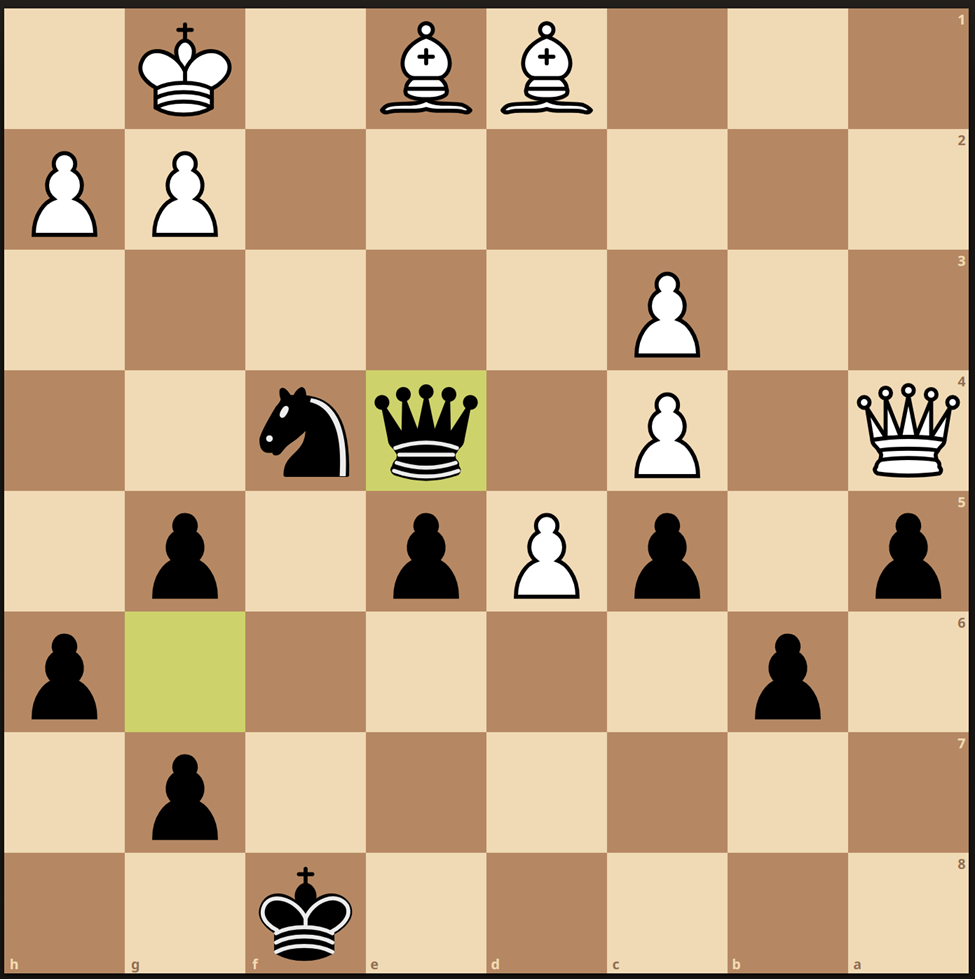
There is mate on e1 and mate on g2! How beautiful is that?!
Also note that if White saw the double mate threat and decided to play 28. Qd2, then 28… Bxd1, 29. Qxd1 Qxe4, 30. Qd2 a4 is totally winning. This position is shown below.

Black is up two pawns in this position with the passed a pawn and more active pieces so at the top level, this is a fairly simple game to win for Bobby. Note that Boris resigned after 27… Bxa4.
Hallo! It’s The Myth Sarang, and today I am back for this blog about my favorite place on Earth, Iceland!
One of my favorite openings as Black that I recently started playing is the Icelandic Gambit! This opening is a very fun one where Black sacrifices a pawn to try to get aggressive activity and development. It arises in the Scandinavian Defense, with these moves:
White Black
e4 d5
exd5 Nf6
c4 e6!?
The position (shoutout to LiChess) is shown below:

Black has deviated from the main lines in the Scandinavian and decides to sacrifice a pawn on e6 for activity and development, as I said before. White plays 4. dxe6. Now, as Black, we want to take the pawn back. 4… fxe6 is not a great move, because we are isolating a pawn that can easily be targeted, and also opening our king to possible attacks on the h5-e8 diagonal. In that case, we will play 4… Bxe6, taking back the pawn and developing our bishop. If you look at the position, you can see that White has not developed a single piece, while we have developed 2, for the cost of one pawn.
The main line for White is 5. d4, putting a pawn right in the center of the board. We now play 5… Bb4+, checking the king, and now we have 3 pieces developed… to 0! We are developing way faster than White. They now play 6. Nc3, finally developing their first piece. We now play the amazing move 6…. Ne4!, and this is the point of the opening, shown below:

Our idea is to put pressure on the pinned piece (PP on the PP, a popular chess phrase, lol), and in this case, the pinned piece is the White knight on c3, so we go for that with moves like Ne4 and Bb4. If White plays the mistake 7. Bd2??, we take the free center pawn with 7… Qxd4 and have a commanding lead in development and have a better position.
There are just way too many threats here, as if 7. Ne2?, we play Bxc4, winning a pawn and we have an IQP (Isolated queen’s pawn) to target in the future. If they play 7. Qc2?! we play 7… Nxc3, they have to take back 8. bxc3, then we play a brilliant move. 8… Qxd4!! It looks like we are sacrificing a queen but they can’t take it due to the bishop’s pin! We also have a deadly threat on c3. This is such a flashy line, and if 9. Cxb4, winning a bishop, we take their rook with 9… Qxa1 and are up material. Here’s a GIF of that line, shown below:
1. e4 d5 2. exd5 Nf6 3. c4 e6 4. dxe6 Bxe6 5. d4 Bb4+ 6. Nc3 Ne4 7. Qc2 Nxc3 8. bxc3 Qxd4 9. Cxb4 Qxa1

I hope you enjoyed this presentation of one of my favorite openings, and now let’s journey onward to the Reykjavik Open, one of the premier chess tournaments in the world!
The Reykjavik Open began in 1964 and was held biennially. Since 2008, it’s been held annually and is now in late March at the Harpa Concert Hall, a very cool-looking building on the water in Reykjavik, Iceland.

This tournament is a very high-level one, with many GM’s (Grandmasters) coming to play this tournament, and many other master-level players and experts.
Mikhail Tal of the Soviet Union, a legendary GM who I think is the GOAT of chess, won the first ever Reykjavik Open in 1964. Other strong Grandmasters who have won this tournament include local Seattle legend Yasser Seirawan as a co-champion in 1990, Alexei Shirov of Latvia in 1992, Levon Aronian (now USA, originally Armenia, then Germany) as a co-champion in 2004, Shakhriyar Mamedyarov of Azerbaijan and Pentala Harikrishna of India as co-champions in 2006, current world top 5 and Fabiano Caruana (now USA, originally Italy) in 2012, Erwin L’Ami of the Netherlands in 2015, Anish Giri of the Netherlands in 2017, Rameshbabu Praggnanandhaa of India in 2022, and the most recent winner, Parham Maghsoodloo of Iran in 2025.
Note that Reykjavik Open Champions Fabiano, Anish, and Praggnanandhaa are all competing in the eight player double round robin 2026 FIDE Candidates tournament in a few weeks to challenge world champ Gukesh for the World Championship. As for Icelandic legends, Hannes Stefansson of Iceland has won 5 Reykjavik Open titles, the most of all time, being a co-champion 4 times in 1994, 2008, 2009, and 2010, and winning solo once in 2000. Friorik Olafsson of Iceland is a close second with 3 titles, being co-champion in 1972 and 1976, and winning sole first in the second ever Reykjavik Open in 1966.
Well, that's all for now. If you are heading to Iceland to participate in the Reykjavik Open this month:
GOOD LUCK AND GREAT GAMES TO ALL!
Three Cheers, Fellow Future Master Chess Friends!
The Man Benji, The Myth Sarang, The Legend Vivaan


Comments