Chess-Time Continuum
Howdy! It’s The Chess Friends!
Happy November! Today we are sharing the article we wrote for the November issue of Northwest Chess magazine. We explore different time controls in chess, highlighting our preferences, which are interestingly different for each of the three of us! We hope you love it, learn something new, and enjoy the award-winning knee-slappers at the end!

Howdy! It’s The Chess Friends!
As loyal readers of the Northwest Chess magazine, you all probably love chess just as much as we do. We wrote before about chess love, where we agreed that it transcends time. So, we thought it’s about time we talk about chess time this time!
There are so many time controls within the chess-time continuum to choose from! How do we make those choices? Among the three of us, why do these choices span the gamut of time controls and increase with age? How do we manage time? Does time manage us instead?
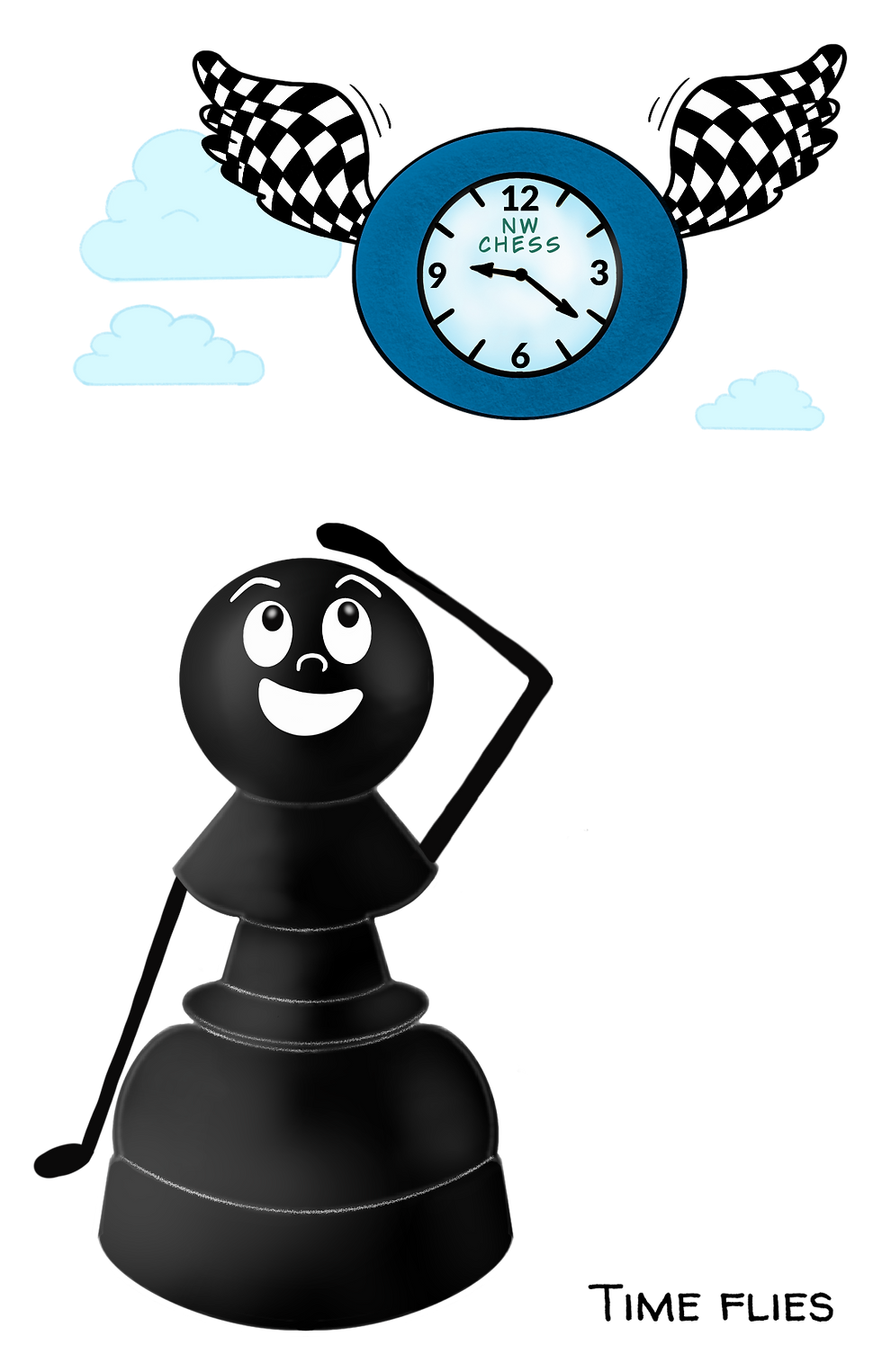
Today we’re going to explore different time controls in chess, why we prefer them, and the ins and outs of mastering time. Peshka is joining us to play the game “Guess the Time Idiom.” Here is the first one, attributed to chess legend Benjamin Franklin (who Peshka decided to be this past Halloween).

The Legend Vivaan
Blitz Time is the Best Time
I love playing speed chess and always have. I’m still 8, though a 5-year chess vet. I get really bored and tired out with longer games. Shorter games are more energetic, more fun, and you get to play more of them in the same amount of time! I also feel a lot less pressure in shorter games as you can just jump onto the next one and have fun. Blunders may happen more, but that’s part of the fun! I feel like I can experiment more, try crazy ideas, sac pieces even if they may not be super sound theoretically, and really play my opponent as much as the position on the board. There is also the thrill of the clock and leaning into time pressure, trusting that I can outplay my opponents in blitz or bullet mode as I always have more time!

As GM Vishwanathan Anand said, “The ticking clock creates a tension that tests not just your chess skill, but your psychological control.” Who will be in control? Let’s play to find out!
Maybe it’s the adrenaline of the moment, but ideas come into my head super-fast and I get to act on them quickly. It’s less about planning and more about instinct. That said, you need to be prepared and get lots of reps in to improve your instincts. The more games you play, the more familiar you become with different positions; the more familiar you become, the faster you can play!
As for specific time controls, I’m not super big on ultrabullet or bullet just because of the physical aspect of it being such a factor. Blitz and fast rapid controls are my favorite: 3+2, 5/0, 10/0 are amazing for me. You have time to trust your instincts and come up with fun aggressive ideas and have the opportunity to deep think at least a couple times a game. I also love chess variants and they’re great with short time controls, especially bughouse! I can play super-fast and get a huge time advantage on my opponent and even if I’m worse, I can stall as needed.
As for over-the-board tournaments, in addition to blitz and short rapid, I also like time controls like G30 or G25+5 or things like that and can manage with anything G60 or less. Not going to lie, when it gets higher than that, I just play G30 anyway and try to stay awake as my opponent thinks forever. When I play G30, I’m basically playing blitz but have a lot more opportunities to think deeply on positions that seem critical to the game. It’s fun as I get a little more time to plan and prepare my attacks while maintaining a time advantage. I also feel very confident coming back in those time controls, because inevitably my opponents get into time pressure, and my positional advantages allow me to break through even if I’m down materially.
On that note, let’s turn it over to my big bro, who’s now a teenager (!!), to talk about mid length time controls.
The Myth Sarang
Take the Middle Path
Usually, as you get older, you tend to slow down and prefer longer time controls. Vivi, 8, likes faster time controls where finding sharp tactics and being familiar with common positions is the meta, and Benji, 14, likes slower games with several hours on the clock where deep calculation and long-term planning prevail.
But for many tournament players, myself included, now 13, the most enjoyable and useful games fall in the middle of the two. First, I will talk about some popular time controls and when they are played, before explaining what time control, in my opinion, is the most useful for serious players.
If you don’t know, “G” means game in: each player receives that many minutes for the entire game. Delay (“/”) and Increment (“+”) are two ways chess clocks give you a small amount of extra time on every move. The key difference is simple: increment adds time to your clock, while delay gives you free seconds before your main clock starts running.
G30 time controls
G30 and variants with increment or delay mostly run 60–75 minutes per round, and they are usually used for:
· One-day scholastic tournaments
· Local club events with 2–3 rounds starting in the afternoon or evening
· A rapid or quick-rated side event for a longer, multi-day tournament
· Tiebreak games, depending on the event format
G60 time controls
These are my personal favorite, because they are right in the middle. The rounds usually take 2–2.5 hours apiece. You may see it in:
· Club championship events
· 2-day weekend tournaments with multiple rounds each day
· Quads and smaller Swiss-paired tournaments
· Scholastic events for stronger players
A G60 game gives enough time for real calculation, opening preparation, strategic planning, and many endgames. It still creates time pressure, especially if a player spends too long in the opening or middlegame. This is, in my opinion, the sweet spot. GM Hikaru Nakamura said, “Time control is the ultimate test of a player’s ability to balance accuracy with speed.” That’s what I am striving for.
G90 time controls
G90 is used for longer, more serious competition where organizers want players to have time for deep calculation and accurate endgame play. It is common in:
Major weekend Swiss tournaments
State, regional, or national championship sections (like the K-12 Grade Championships and the National ES/MS/HS Championships at G90/10)
Strong open sections (like the US Open 5-day section, where the first six rounds are G90/5)
FIDE-rated classical events
League matches and invitational events (like the Invitationals at the US Open at G90+30)
G90 is often preferred for strong sections because it reduces games being decided only by frantic time scrambles. Players still need clock discipline, but they have more time to calculate sacrifices, assess pawn endings, and recover after a difficult position.
Chess time controls from G30 to G90 offer a valuable middle ground between the speed of blitz and the depth of classical chess. They are long enough to reward calculation, strategy, and endgame skill, while remaining practical for school players, club competitors, coaches, and weekend tournaments.
For players who want to improve, these controls encourage the habits that lead to stronger chess: checking threats, comparing candidate moves, managing the clock, and analyzing mistakes honestly. Blitz can be fun, and classical chess can be deeply rewarding. But for many players, like me, the real sweet spot is somewhere between G30 and G90, where there is enough time to think, but not enough time to waste.
The Man Benji
The Longer the Game, The Better. Until It’s Not!
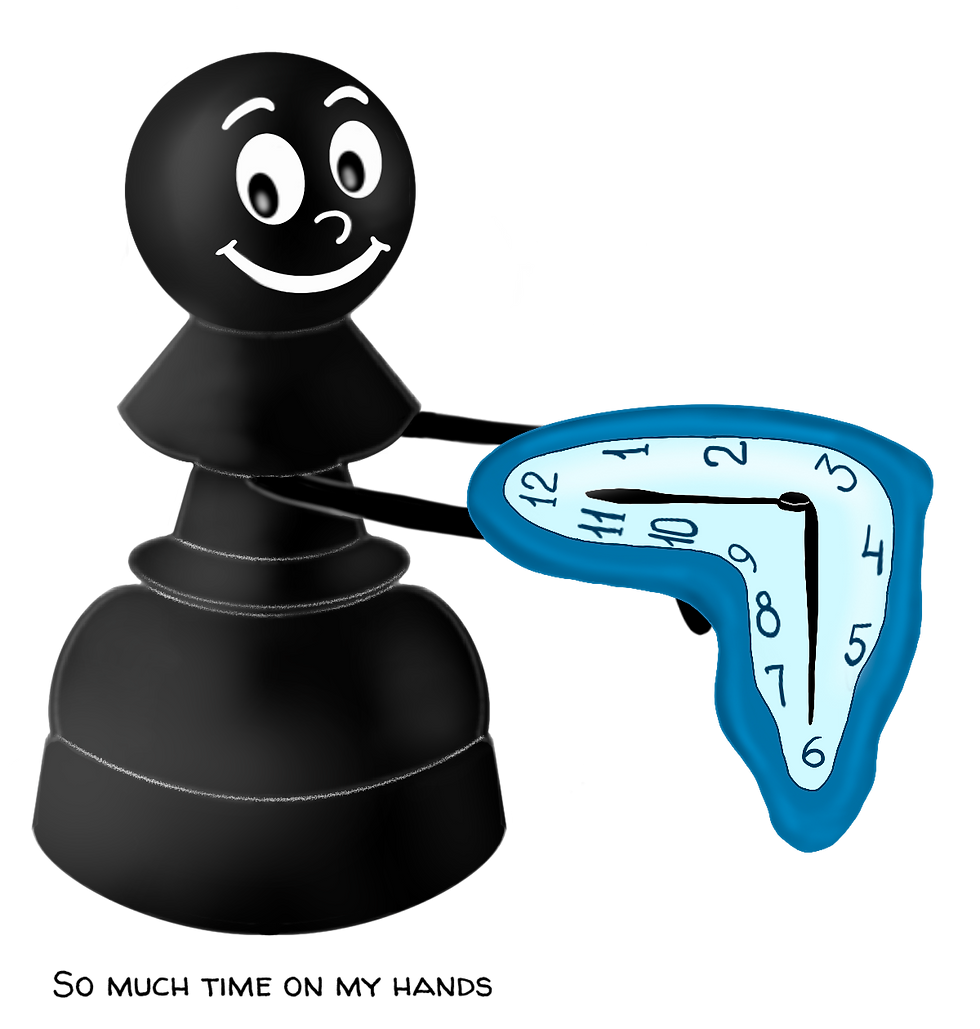
Yes, that is true: longer time controls are the best. For me, anyway. Give me 2 hours on the clock and I’ll use it all. My average classical game lasts 4 hours! But it hasn’t always been that way.
Back when I was young, so young that I wasn’t the Man Benji but the little child Benji, I used to be your typical G5 chess kid. I would look at the board, see a move, and play it instantly, trusting my intuition. Sooner or later I would find out if the move was good or a blunder.
Of course, my coach told me to slow down and think before moving, but I enjoyed the thrill of playing fast. Then one day, I decided to try this thinking-before-moving thing. Explore my options. See if the move was safe. Find a plan.
I followed through and realized: hey, thinking is actually fun! It’s like when you drive from Seattle to Spokane, and, instead of taking the fastest route, you stop to look at the wind turbines, smell the flowers, greet the mighty Columbia River, and eat at a Chipotle in Moses Lake. So many possibilities! By slowing down, I started to notice them—positional ideas and tactics on the chess board.
At that time, I was playing mainly G30 quad games, and I actually started using all my time on the clock. Still, I could only afford no more than 3 minutes per move on average (not that much time to peacefully finish a burrito if you ask me), so I ended up getting into more and more time scrambles.
The G30 time control didn’t work for me anymore. As my game matured, I moved into higher levels of competition, playing in bigger tournaments with slower time controls. I started thinking not just about my own plan, but also about my opponent’s, and how I would respond. I needed more time to smell all the flowers, and I would use more and more time on my clock, now getting into time scrambles in longer classical games!
It became a problem. A big disadvantage, when I would reach winning positions but don’t have enough time on my clock to convert. As GM Magnus Carlsen said before, “Time management is just as important as calculation. You can have a winning position, but if you have no time, you have nothing.” I wasn’t managing my time well!
The crazy thing is that I even didn’t feel like I was spending that much time during my games! That’s Albert Einstein and the theory of relativity at work! You know how the faster you move the slower time goes. It was experimentally proven with two clocks, where one clock that traveled on the airplane around the globe showed that less time had passed compared to the clock that remained on the ground. You’ve probably seen sci-fi movies, where the hero goes on a mission in space, and their rocket is traveling close to the speed of light. When they return home, it’s only been an hour or two for them, while everyone on Earth has aged big time!
I am that hero on a chess space mission! Thinking hard about my position, my mind whizzes through different ideas, calculating, never stopping, never giving up. I hardly notice the time going by at all, while people, watching my game, feel like they age faster, waiting for me to return back to Earth with a heroic chess move.
But it’s easy to get lost in this chess spacetime travel and burn all the time on your clock. When that happens, I get into time scrambles and have to play fast, making my moves in the nick of time, embracing every second of it. It is stressful.
I had to do something to avoid getting into so much time pressure. One option was to switch to an even longer time control (correspondence chess? I have to travel back in time for that!). Another option: fix my time management. This is where I am right now. Let me tell you, it’s a process.
During my games now, after each move, I write down on my scoresheet how many minutes I have left on the clock. Then, when I analyze at home, I can see where my time trickles down the most. I noticed that I often fall into the trap of thinking long in calm positions, when the plan is to slowly build your advantage by bringing your pieces to better squares, and where the dynamic of the game is not changing much.
Of course, some critical or wild positions require me to think deeper and devote more time to them, but calm positions are usually the ones where I burn my time a lot. Now I try to spend no more than 3 minutes per move if the position is calm, while in a crazy position, I allow myself longer thinks, 5–10 minutes, or sometimes even more.
Fixing time trouble is a slow process; nobody can expect it to suddenly disappear overnight. It can take months, maybe even a year. I will let you know later how that goes! It’s something that comes with more experience, understanding of certain positions better, and most importantly, believing in yourself! As with the pressure of competition that we talked about before, I’m getting to become friends with time, so my clock and I can work together during the chess game and travel anywhere on the chess-time continuum!
As you can see, the three of us have very different preferences when it comes to chess time controls. That doesn’t mean we don’t play the other controls, but rather we have our preferences and ways of thinking and managing time that best suits us.
Interestingly, our time choices perfectly correlate with our ages, getting slower as we get older. Will that change over time? Maybe. Only time will tell. We know many adults who exclusively play speed chess!
Whatever your opinion is of time, we hope reading this has inspired you to lean into some time controls out of your comfort zone and let your love of chess transcend the chess-time continuum!
Before you go, please take your time to enjoy these timely knee-slappers!
-Knock, knock.
-Who’s there?
-Ben.
- Ben, who?
- Ben playing this chess game for hours!
***
What did the chess clock say to Benji in time trouble?
“Hour you doing?”
***
What did Benji reply to his clock?
“Shhh! You are tocking too much!”
***
What is the best time to start a chess tournament?
6:30. Hands down.
***
How do you call an old analog chess clock?
An old timer.
***
Why did the clock miss the first round of the chess tournament?
It was running late.
***
What did the chess clock do when the game lasted 24 hours?
Called it a day!
***
Why is the air quality so bad during a classical chess tournament?
Because players keep burning their time!
***
Three Cheers, Fellow Future Master Chess Friends! Together with Peshka, we hope that, no matter the time control, you’ll have a whale of a time in your next tournament!

The Man Benji, The Myth Sarang, The Legend Vivaan


Comments