Chess Books for All
- May 22
- 9 min read
Howdy! It’s The Chess Friends!
In case you are new to our blog, we are three kid authors who published a book Q&A Chess: Tournament Edition last September. We’re working on a new book as well but more on that later!
Today we’re going to review a few other chess books for kids and grown ups!

The Myth Sarang and The Legend Vivaan
One of the major themes of our writing is learning with joy, and all these books do that brilliantly. We have been studying neuroscience and the science of learning a lot recently and wanted to highlight some of the major benefits of learning with joy.
Learning with joy promotes better executive function skills, a challenge for many of us neurospicy folks. It helps with cognitive flexibility and leads to better problem solving and self-regulation. If our brains in focus mode are activated with joyous learning, the networks formed will myelinate better in diffuse mode, even when we are sleeping, leading to more retention. Positive links that are created with joyous learning also make memories stick better by connecting new ideas with stored memories in the limbic system. Happy learning creates dopamine release stimulating the hippocampus (memory center), and boosting attention, retention, and motivation.
Chess For Babies
by Levy Rozman aka GothamChess, Illustrations by ¡Zamora!
The Legend Vivaan
This book is amazing! It teaches babies a little history of chess, the names of the pieces, how they move, and more, in a fun, experiential way that’s perfect for new learners. We’ve even read it to our baby cousin sister, who’s only one year young, and now she knows the names of the chess pieces! Our buddy Levy, one of the most enthusiastic, quirky chess personalities out there (if you haven’t seen his youtube.com/@gothamchess videos, check them out) and ¡Zamora! do an awesome job with pictures, colors, fonts and bolding in this book, so babies of different ages can learn the basics of chess at different levels. Solving chess puzzles is a major theme of studying chess at every level. Levy does a great job encouraging babies to solve perhaps the most important of all chess puzzles, namely how the pieces move, in fun ways they can enjoy!
The biggest boldest words are the names of the chess pieces. There are colorful suggestions telling babies to use their fingers to mimic the movements of the smiling chess pieces on the pages. There are bold words that summarize the basic way the pieces move. There are also more words on each page that explain things in more detail so maybe the people reading the book with the babies have more context. It’s also full of positive reinforcement and encouragement: Hurray!, Good job, Baby., “You’ll play a game soon.”, etc. If you have any babies in your life, we highly recommend this book to give them a great start and begin building those critical neuro-connections through chess! If you start your kiddos with Levy’s books and ours, they’ll be tournament players in no time!

by Vishnu Warrier, Illustrations by Diriq
The Myth Sarang
This whole series of books by our buddy Vishnu is incredible! Volume 1 does an amazing job building an understanding of the basics of chess through an alphabet book for young learners. Each pair of pages features a letter, a chess term starting with that letter, a chessboard highlighting what the word means, an explanation of what the word means, and a fun story with cool pictures! Honestly Diriq’s illustrations are the best I’ve ever seen in a chess book, tied with our buddy Peshka in ours!
The blurbs in the book remind me a lot of Peshka giving fun, comical, friendly advice. Vishnu also gives some great dad/coach life advice like “eat your vegetables” regularly in the book! My favorite letter in the book is “E” for “En Passant”, a concept tricky for some experienced chess learners too. The illustration is fire and the text says “Peter Pawn didn’t want to wait to ride the roller coaster so he used en-passant to cut the line.” The picture and explanation make en-passant super clear as well even though it’s a tricky concept! My other favorite is “I” for “Isolated Pawn” and my favorite part is the Pawn on an isolated island in the water with a blurb that says “Anyone here?” Hahahahaha! Just like Peshka!
If you’re into coloring, check out Volume 2! When you get to Volume 3, you will be blown away! It has the same concepts with a term for each letter, but it’s presented in what I would call rap bars, amazing rhyming lyrics to really build those brain connections and deeper understanding! So clever and imaginative!
My Dad reviewed this one and said: “With Dr. Suess-esque rhymes and super fun cartoons by Diriq, this book will be a hit for kids, parents and coaches alike! It highlights many key chess ideas with easily understandable images to complement the rhymes. Oh, and if you’re a rap fan like me and my chess kids, each page also makes a fabulous chess rap! Enjoy!”
I would recommend starting your kiddos with Vishnu’s books to get them excited about learning chess and building those fundamental neural networks then reading ours to continue their joyous journey in chess and get them tournament ready!
If you can't get enough of chess alphabet books, check out this one: Chess Legends Alphabet by Beck Feiner (2024), https://www.thirdplacebooks.com/book/9780645851526
We reviewed it in one of our earlier blogs here.
The Man Benji
Hey, it’s The Man Benji!
When you grow to be The Man, you discover that books can get heavy. Not only because there are more pages to an adult book, but its topics can get heavy. Heavy-heavy.
But like English philosopher Francis Bacon said back in Shakespearian times:
“Reading maketh a full man; conference a ready man; and writing an exact man,”
we read books, discuss them, and write about them, to learn, grow, share, and connect.
Today, I have two books to share. Written 70 years apart, in different languages, different cultures and styles, these two books are linked by a timeless subject: chess. They both feature two people who gave up the game for 30 years, under different circumstances, but with the same underlying reason. Pressure. Both stories set the stage for these chess masters in hiding to go back on the big stage to play a game. How does one deal with the pressure? Is giving up the right answer? The books are inviting you to ponder on that.
Chess (1943)
by Stefan Zweig

Written in 1942 in German language and first published in 1943, this short story comes to us from the Austrian writer Stefan Zweig, who wrote it in his exile in Brazil. It is a classic!
On a large steamer voyaging from New York to Buenos Aires, the passengers are thrilled to discover that among them is a world chess champion, a reclusive guy who avoids any contact, “a strange genius, or an enigmatic fool.”
Imagine the excitement! Being stuck on the boat with a world chess champion! A game must be arranged! And so it is, between chess-playing enthusiasts and him, which he, of course, easily wins. A rematch follows, destined to have the same outcome, but an intervention from some unremarkable guy who takes control of the moves turns the game into a draw.
Well-well-well, now the third game absolutely has to happen, between these two formidable opponents. But who is this guy, so good at chess, drawing a champ, but claiming he hasn’t touched chess pieces for almost thirty years?
Dr. B. tells his story about how he learned chess under “unprecedented circumstances.” He was captured by nazis and placed in a hotel room, to be tortured with complete isolation, because he held valuable secrets on the imperial family. No views, no sounds, no books, no pens, no sense of time. Nothing. Only you and your thoughts. Alone. Alone for months. Then interrogations. Then back to Nothing.
Thinking he couldn’t go on like this any longer, Dr. B. steals a book from the coat of one of his interrogators, to save his mind with some printed words. Oh, to read at last! Not alone any longer! The book turned out to be a collection of chess matches. What a disappointment at first for Dr. B. With breadcrumbs for chess pieces and checkered bed spread for a chess board, Dr. B learned to play and appreciate chess, memorizing the games one by one, his mind saved from Nothing! Replaying the matches in his head was like talking to all these chess masters! But with time, chess, once a delight, turned into a mania, games against himself.
How did Dr. B. get out of the prison? How will his match against the champion on the boat go? Pick up this book to find out!
Does chess have the healing power, or the chilling power? What can chess pressure do to you? Written from the point of view of an outsider, the story invites you to think about these questions, about what chess is. Like Mr. Zweig puts it:
chess is “…a unique link between pairs of opposites: ancient yet eternally new; mechanical in structure, yet made effective only by the imagination; limited to a geometrically fixed space, yet with unlimited combinations; constantly developing, yet sterile; thought that leads nowhere; mathematics calculating nothing; art without works of art; architecture without substance – but nonetheless, shown to be more durable in its entity and existence, than all books and works of art; the only game that belongs to all nations and all eras.”
Fun fact: The game that was drawn between the passengers and the world chess champion on the boat was inspired by a real game; check it out and try to figure out why Black shouldn’t promote to a queen on move 38!
Alexander Alekhine vs Efim Bogoljubov, Pistyan (1922)
Definitely a must read!
Grandmaster (2015)
by David Klass

This novel is an upper-middle grade/young adult category. It has some heavy subjects, and I would recommend it to those 15+ years old.
A 9th-grader Daniel of New Jersey feels like he doesn’t have any talents, sports or otherwise, so he decides to join his school’s chess club. It’s less time consuming in his busy schedule full of homework. He is a total beginner and loses a lot, so he’s surprised when the two best players in his club invite him to the National Tournament for Parent-Child Teams, held in New York. A team should consist of six people, three parent-child pairs, but why on earth would they invite Daniel of all people?
…Because they know something about his father, something that even Daniel doesn’t know. His father is a Grandmaster! Why did his Dad keep it a secret from his family for nearly thirty years? Why did he remain so indifferent, didn’t even flinch a finger, when Daniel was studying the Fried Liver Attack in the living room in front of him?
Confronted by Daniel, Dad agrees to travel to New York, to play just this one tournament. But at what cost? What bad memories, kept in the dark closet for so long, will resurface? And would his Dad be able to win games, after staying away from chess and not keeping up with theory for so long? Will Daniel finally believe in himself?
Yes, this book has heavy themes; yes, it shows what the pressure of chess tournaments can do to some people; yes, it describes how stressful people can become during a match. But…
…But it also shows how chess can bring people together, how it equalizes people, how it helps to form new friendships, new bonds. It shows that the father-son bond can be stronger than any pressure of the past or any chess pressure.
Although some “chess parents” situations were a bit grotesque, the author gives sound chess advice, and really gets the vibes of chess tournaments. For example, check out this gold:
“There is a moment at a chess tournament when the silence takes hold. […] …the mass concentration of the participants seems to knit together into a heavy blanket that dampens all peripheral sounds.”
Well done!
The Chess Friends
If you noticed, friends, the links to the books we reviewed here are to the Seattle-area independent bookstore Third Place Books. Third Place Books promotes chess and The Chess Friends! This is the place where we launched our book back in December! You can read about our experience here, in our blog.
Third Place Books has been hugely supportive of our writing journey, and they keep supporting chess in the Seattle area!
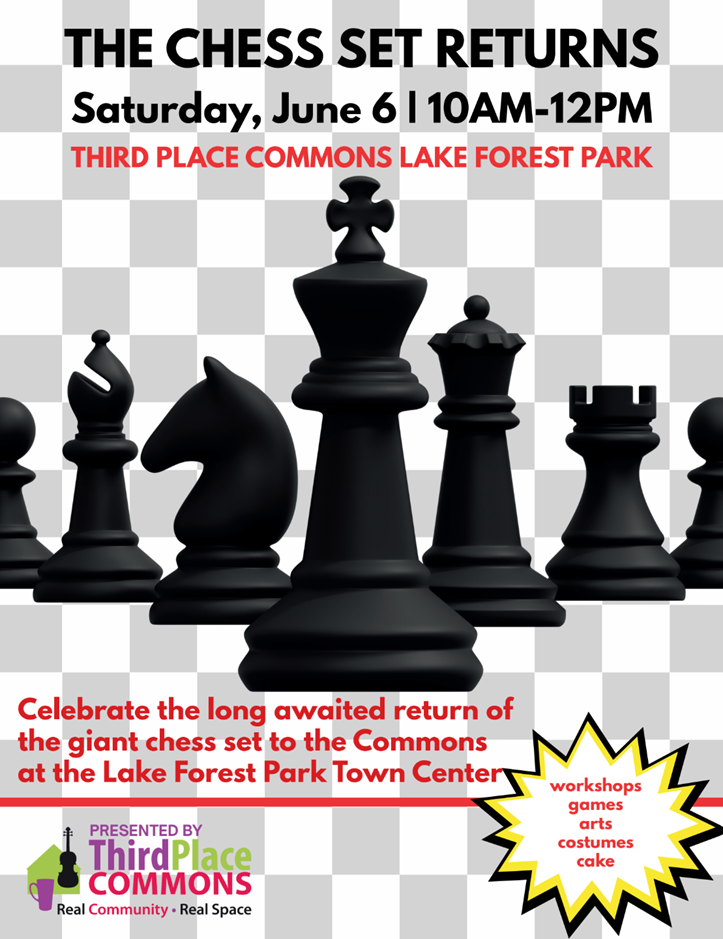
Please consider joining them and us Saturday morning, June 6th, at Lake Forest Park Third Place Commons for the community chess event to welcome back the giant set!
You can learn more about the event here: The Kings & Queens (& Knights & Bishops) Return | Third Place Commons. Third Place Commons is an awesome community center with great food, good vibes, and lots of great activities, including chess! Be sure to check it out!
Three Cheers, Fellow Future Master Chess Friends!
The Man Benji, The Myth Sarang, The Legend Vivaan


Comments